

Pilgrimage routes & yatras
Spiritual journeys
India's great spiritual circuits, written for someone who has never done one. Every guide covers the season, the difficulty, how the road actually works, how to behave at the shrines, and what first-timers get wrong.
Before you go anywhere
A pilgrimage is not a holiday that happens to end at a temple, and the travellers who enjoy these journeys most are the ones who understand that before they set out.
You will queue. You will get up at four in the morning more than once. You will walk further than you expected and you will be cold, or hot, or both on the same day. Your moment in front of the deity will last a handful of seconds after ten days of road.
And somewhere in the middle of all that — usually not where you were expecting it, often on a walk down or at a tea stall or in a hall full of strangers eating the same food — something will land.
That is the trade. If it sounds worth making, pick a route below. Each one is written the way I would brief you the night before we left.
Choose your journey
12 routes, from a gentle week on the plains to the hardest walk in Asia.

Amarnath Yatra
The Amarnath Yatra travels to a cave shrine at around 3,888 metres in the Lidder valley of Kashmir, where a stalagmite of ice forms naturally each summer and is worshipped as a lingam of Shiva. It grows and shrinks through the season, and its size in any given year is genuinely unpredictable. The yatra runs for a limited window each summer, usually across July and August, traditionally concluding on Shravan Purnima — the full moon that is also Raksha Bandhan. Outside that window the route is closed and the cave is under snow. There are two ways in. The traditional route from Pahalgam is around forty-six kilometres and takes three to five days, climbing through Chandanwari, past the glacial lake at Sheshnag, over the Mahagunas pass and down to Panchtarni before the final approach to the cave. It is longer, gentler in gradient and far more beautiful. The route from Baltal is around fourteen to sixteen kilometres and can be done in a long day each way, but it is steep and unforgiving. Helicopter services operate to Panjtarni from both sides in season, weather permitting. Everything about this yatra is governed by the Shri Amarnathji Shrine Board: registration, the compulsory health certificate, the RFID cards, the daily numbers allowed onto each route, and the dates themselves.
Roughly July to August only — the yatra runs for a few weeks each summer and the cave is inaccessible the rest of the year 3 to 6 days from Pahalgam; 2 to 3 days from BaltalHard — a high-altitude trek to 3,888 m on a short, weather-exposed season

Buddhist Circuit
The Buddhist Circuit traces the key sites of the Buddha's life and the spread of his teachings across the Gangetic plains and central India — from his enlightenment at Bodh Gaya to his first sermon at Sarnath and final nirvana at Kushinagar, taking in the great monastic universities of Nalanda and Rajgir and the ancient stupas of Sanchi.
October to March 7 to 12 daysEasy — all by road and rail, on the plains

Char Dham of India (the original four)
The original Char Dham — the "four abodes" — are the shrines at Badrinath in Uttarakhand, Dwarka in Gujarat, Puri in Odisha and Rameswaram in Tamil Nadu. Tradition credits Adi Shankaracharya, the eighth-century philosopher, with establishing them as a single all-India circuit, one at each cardinal point of the subcontinent. They are not a themed collection. Badrinath is Vishnu in meditation in the high Himalaya. Dwarka is Krishna as king, on the coast where his legendary city is said to have stood before the sea took it. Puri is Jagannath, "lord of the universe", in a form found nowhere else — a wooden image with enormous round eyes, remade at intervals in a secret ritual, and carried out once a year on chariots so large the English word "juggernaut" comes from them. Rameswaram is Shiva, in a linga that tradition holds was installed by Rama himself before crossing to Lanka. Between them they cover roughly six thousand kilometres of travel and two entirely different climates. Completing all four is considered by many Hindus to be the pilgrimage of a lifetime, and it is common to do it in stages across several years rather than in one continuous journey.
October to March for Puri, Rameswaram and Dwarka; Badrinath only opens May to October 14 to 21 days, or spread across two seasonsModerate — the shrines themselves are easy; the distances are the challenge

Char Dham Yatra (Uttarakhand)
The Char Dham Yatra of Uttarakhand — also called the Chota Char Dham, to distinguish it from the all-India Char Dham of Badrinath, Dwarka, Puri and Rameswaram — links four Himalayan shrines: Yamunotri, Gangotri, Kedarnath and Badrinath. Two of them stand at the sources of India's two most sacred rivers. All four sit above 3,000 metres, close under the snow line, and all four are closed and empty through the winter. The shrines open around Akshaya Tritiya in late April or May and close around Bhai Dooj, just after Diwali. In between, the deities of Kedarnath and Badrinath are carried down to their winter seats at Ukhimath and Joshimath, and the doors are shut against the snow. That opening and closing is not a formality — it is why the yatra has a season at all, and why the road is so crowded inside it. Pilgrims travel the four in a fixed clockwise order — Yamunotri, then Gangotri, then Kedarnath, then Badrinath — a sequence that has been followed for centuries and that still shapes how the roads, the halts and the towns along the way are organised.
May to October 10 to 12 daysDemanding — long mountain roads; two shrines reached on foot above 3,000 m

Christian Pilgrimage Circuit
This circuit gathers India's great Christian pilgrimage sites — the UNESCO churches of Old Goa with the relics of St. Francis Xavier, the Marian basilica of Velankanni, and the St. Thomas hill-shrine of Malayattoor — spanning the country's Portuguese-era and ancient St. Thomas Christian heritage.
October to March flexible; individual shrines or a southern circuitEasy — level shrines and towns; only Malayattoor involves a climb

Jain Tirth Circuit
This circuit links the holiest Jain pilgrimage sites (tirthas) of India — from Shikharji, where most Tirthankaras attained liberation, to the marble temple-cities of Palitana, Ranakpur and Dilwara, the giant Bahubali monolith at Shravanabelagola, and the sacred peak of Girnar.
October to March flexible; individual tirthas or a multi-week circuitStrenuous — four of the six tirthas are hills climbed barefoot, one of them for 27 km

Kailash Mansarovar Yatra
The Kailash Mansarovar Yatra travels to Mount Kailash and Lake Mansarovar on the remote western Tibetan plateau. It is among the most sacred pilgrimages in Asia and, by a distance, the most physically severe that ordinary pilgrims attempt. The journey has two centres. Lake Mansarovar sits at around 4,590 metres — a vast, still, astonishingly blue body of water where pilgrims bathe and perform parikrama. And above it stands Kailash itself, a dark pyramidal peak of about 6,638 metres with a snow cap, around whose base pilgrims walk the kora: fifty-two kilometres, usually over three days, crossing the Dolma La pass at roughly 5,600 metres. Some Tibetan pilgrims perform the whole circuit in body-length prostrations, which takes weeks. Nothing about reaching it is simple. Kailash lies inside Tibet, and access from India depends on arrangements between the two governments that have been suspended for long stretches. The government-run yatra crosses at Lipulekh in Uttarakhand or Nathu La in Sikkim; the alternative is an overland route through Nepal run by private operators. The season is short — roughly June to September — because for the rest of the year the plateau is closed by snow and cold.
June to September 12 to 24 daysSevere — the hardest pilgrimage most people will ever attempt; days above 4,500 m and a pass near 5,600 m

Shakti Peethas & the Devi Circuit
The Shakti Peethas are the shrines that mark where the body of the goddess Sati fell to earth. Traditional lists vary — fifty-one is the most commonly cited number, though some texts count eighteen and others a hundred and eight — and they are spread across India, Nepal, Bangladesh, Pakistan and Sri Lanka. In practice, travellers encounter them as clusters. Bengal and the east hold the densest concentration: Kalighat in the middle of Kolkata, Tarapith with its cremation-ground tantric tradition, Bakreshwar, Attahas, and across the border in Assam the great temple of Kamakhya on Nilachal hill. Himachal Pradesh has its own famous group — Jwalamukhi, where natural gas flames burn from the rock and are worshipped as the goddess; Chintpurni; Naina Devi; Bajreshwari at Kangra — routinely done as a single circuit of a few days. Vaishno Devi in Jammu, reached by a twelve-kilometre climb from Katra, is among the most visited shrines in the world. Maharashtra has Tulja Bhavani and Kolhapur's Mahalakshmi; the south has Kanyakumari at the very tip of the country and Srisailam's Bhramaramba, which is a Shakti Peetha and a jyotirlinga on the same hill. No one visits all of them. Most pilgrims take a cluster, often at Navratri, and return for another in a later year.
October to March; Navratri in spring and autumn is the great season Best in regional clusters; 5 to 7 days per clusterEasy to moderate — several shrines involve a hill climb of a few kilometres
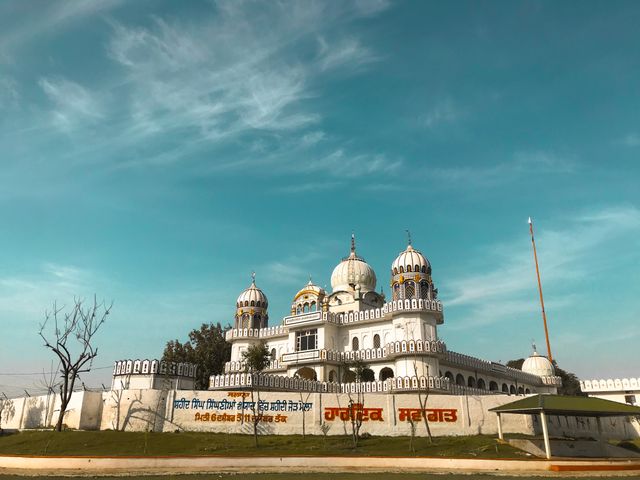
Sikh Takht & Gurdwara Circuit
This circuit links the supreme seats and great gurdwaras of Sikhism — from the Golden Temple at Amritsar to the Takhts of Anandpur Sahib, Damdama Sahib and Hazur Sahib at Nanded, and the high-Himalayan shrine of Hemkund Sahib — tracing the spiritual geography of the Sikh faith.
October to March (Hemkund May to October) flexible; a multi-state circuitEasy — all by road and rail, except Hemkund Sahib, which is a hard high-altitude trek

Sufi & Dargah Circuit
This circuit traces India's most revered Sufi shrines and historic mosques — from Ajmer Sharif, the heart of South Asian Sufism, to the qawwali lanes of Nizamuddin, Mumbai's sea-shrine of Haji Ali, the grand Jama and Mecca mosques, and Kashmir's Hazratbal — a journey through India's syncretic Islamic devotion.
October to March flexible; individual shrines or a multi-city circuitEasy — city shrines, all reachable by road, rail and air

The Great Temples of the South
Tamil Nadu and its neighbours hold the densest concentration of living temple architecture anywhere in the world, built across a thousand years by the Pallavas, Cholas, Pandyas, Vijayanagara kings and the Nayaks — and almost all of it still in daily ritual use. The trail usually strings together Madurai's Meenakshi Amman temple, with its fourteen towered gateways; Srirangam near Tiruchirappalli, the largest functioning Hindu temple complex in the world, at over one hundred and fifty acres inside seven concentric walls; Chidambaram, home of Shiva as Nataraja, the cosmic dancer; Tiruvannamalai, where a fourteen-kilometre walk around a sacred hill is itself the act of worship; and Kanchipuram, a city of temples that was capital to the Pallavas. Nearby lie the great Chola temples of Thanjavur, Gangaikondacholapuram and Darasuram — a UNESCO World Heritage group and the high point of south Indian architecture — along with Rameswaram at the tip, Palani's hill shrine to Murugan, and, across the border in Andhra Pradesh, Tirumala, the hill temple of Venkateswara, which receives more pilgrims than almost any other place of worship on earth. Several belong to older systems that cut across the geography: the Pancha Bhoota Sthalams, five Shiva temples representing the five elements, are scattered through this same region — earth at Kanchipuram, water at Thiruvanaikaval, fire at Tiruvannamalai, air at Srikalahasti, and space at Chidambaram.
November to February; avoid April to June 12 to 16 days for the full Tamil Nadu trail; 5 to 6 days for a shorter loopEasy — level temple towns, though Tiruvannamalai's hill walk is 14 km and Palani has a climb

The Twelve Jyotirlingas
A jyotirlinga is a "linga of light" — one of twelve places where Shiva is held to have manifested himself as a column of fire with no beginning and no end. They are the most sacred Shiva shrines in India, and they are scattered deliberately wide, from the Arabian Sea to the eastern plains and from the high Himalaya to the southern tip. The twelve are Somnath in Gujarat; Mallikarjuna at Srisailam in Andhra Pradesh; Mahakaleshwar at Ujjain and Omkareshwar on the Narmada, both in Madhya Pradesh; Kedarnath in the Uttarakhand Himalaya; Bhimashankar, Trimbakeshwar and Grishneshwar in Maharashtra; Kashi Vishwanath at Varanasi; Vaidyanath at Deoghar in Jharkhand; Nageshwar near Dwarka; and Rameshwar at Rameswaram in Tamil Nadu. Several belong to more than one great circuit at once. Kedarnath is one of the four Uttarakhand dhams. Rameswaram is one of the original all-India Char Dham. Somnath, Nageshwar and Dwarka sit within an hour or two of each other on the Saurashtra coast. That overlap is not accidental — it is how Indian pilgrimage has always been organised, in layers rather than in lines. Doing all twelve is a serious undertaking. Doing three or four well is a genuinely good holiday.
October to March; avoid Shravan (July–August) unless you want the crowds Best done in regional clusters over several trips; 25 to 30 days end to endModerate — mostly level temple towns, except Kedarnath, which is a 16 km climb
If you have never done this before, read this first
Eight things that hold true at almost every shrine in India, whatever the faith. Get these right and you will be treated as a guest everywhere you go.
01
Shoes come off, heads get covered
Almost every shrine in India is entered barefoot, and there will be a stand near the boundary where everyone else has left their footwear — that crowd of shoes is your line. In gurdwaras and at Muslim shrines you also cover your head, and both keep spare scarves at the door for visitors who arrive without one. Carry a large cotton scarf and you are equipped for the whole country.
02
Cover your shoulders and your knees
Nobody is checking with a ruler, and nobody will be unkind about it. But these are working places of worship rather than monuments, and simple modest clothing is the difference between blending in and being the person everyone is politely not looking at. It is also usually more comfortable, because you will be in the sun.
03
Your darshan will last seconds, and that is normal
First-timers fixate on the moment in front of the deity or the relic. At a major shrine that moment is measured in seconds, a priest or a guard will move you along, and this happens to lifelong devotees too. The feeling is not in the queue — it is in the aarti or the kirtan or the qawwali, which lasts an hour and which you can simply sit down and be present for. Plan your day around that, not the queue.
04
Go clockwise, and take prasad with your right hand
Circumambulation — parikrama, pradakshina, kora — moves clockwise, so keep the shrine on your right. Food or blessed offerings are given and received with the right hand, and they are meant to be eaten rather than pocketed and thrown away later. When in doubt about anything at all, watch the person next to you and do what they do. It is a reliable rule everywhere in India.
05
Photograph the courtyard, not the sanctum
Outside is almost always fine. Inside, where the deity or the tomb is, put the phone away — there are usually signs, and where there are not, the absence of anyone else photographing is the sign. Never photograph a person in prayer, in tears, or completing a vow. If you would not do it in a hospital, do not do it here.
06
Most of these places will feed you
The langar at a gurdwara, the bhojanshala at a Jain tirtha, the prasad at a temple, the niyaz at a dargah — being fed is a central religious act across Indian traditions, not a courtesy to tourists. Sit down in the row, accept what you are given, finish it. It will be the part of the day you remember.
07
Train your legs before you book anything
The single biggest predictor of whether a first-time pilgrim enjoys their yatra is not devotion or planning — it is fitness. Kedarnath is sixteen kilometres uphill. Palitana is three and a half thousand steps, barefoot. Six weeks of daily walking with some stairs in it transforms these journeys from an ordeal into a pleasure.
08
Build in days you do not plan to use
Mountain roads close, weather grounds helicopters, landslides happen, festivals fill towns. A yatra with no slack in it is a yatra that will break. Give yourself spare days and let the mountain, or the crowd, or the tide set the pace. Every experienced pilgrim in India already travels this way.