
Palaces & Havelis
Heritage
Royal residences still standing — and the merchant havelis that out-decorated them.
36 places
Thanjavur (Brihadeeswarar Temple)
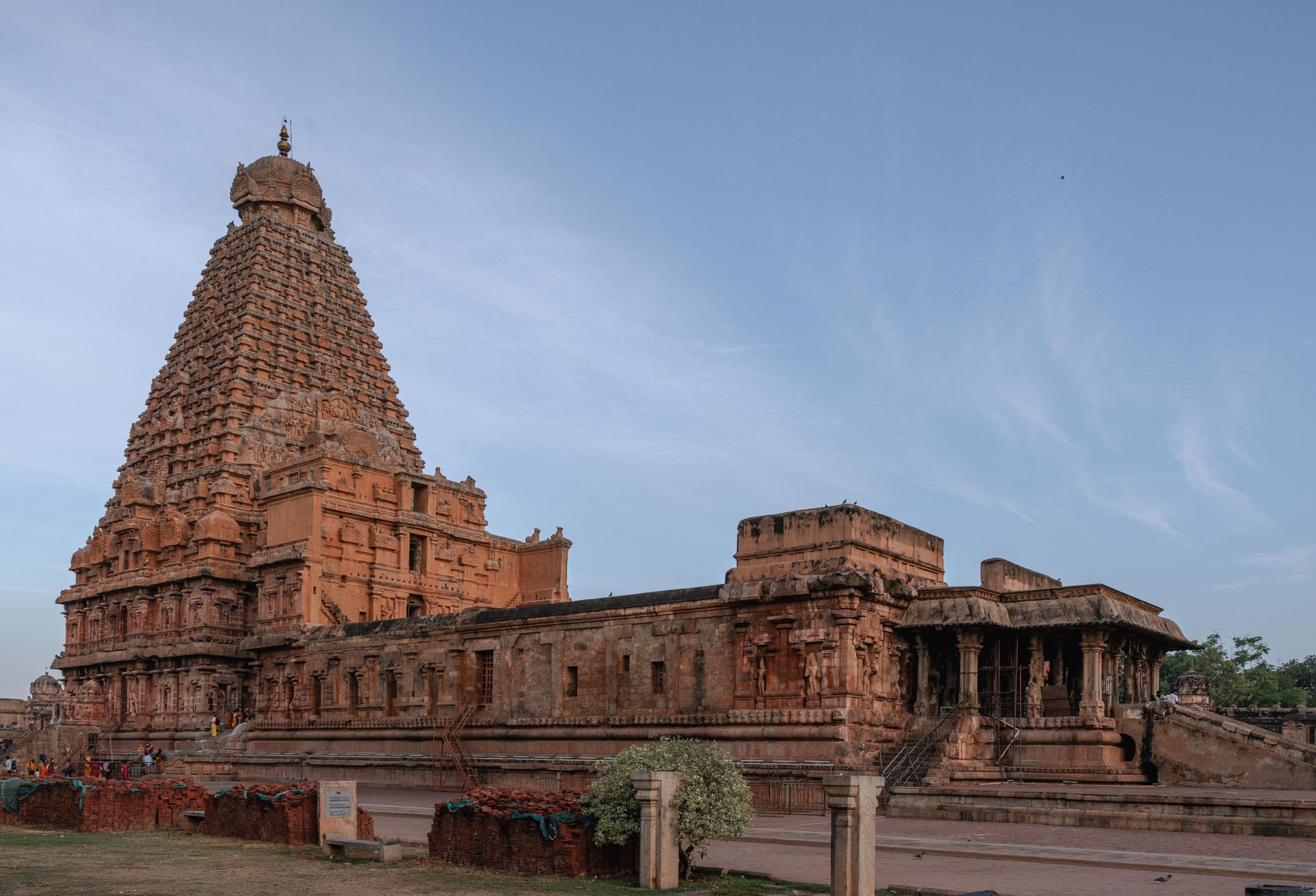
Thanjavur Royal Palace Complex
The historic palace quarter located nearby, hosting the legendary Saraswathi Mahal Library filled with rare palm-leaf manuscripts and ancient art collections.
Bikaner
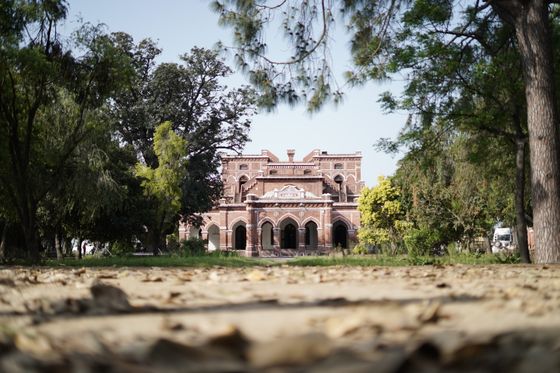
Rampuria Haveli Cluster
A street of merchant mansions in red Dulmera sandstone, late nineteenth century, carved front to back. Most are still lived in or shut up, so this is a walk past facades rather than a tour — go with someone from the old city.

Kochi (Fort Kochi)
Mattancherry Palace
A historic palace built by the Portuguese and renovated by the Dutch, housing rare multi-century old murals detailing the Ramayana.

Leh, Leh & Ladakh
Leh Palace

Pune
Aga Khan Palace
A grand palace and Gandhi national memorial set in gardens.
Jaisalmer
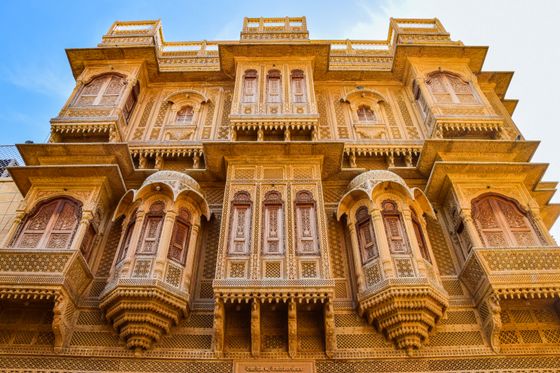
Patwon-ki-Haveli
Five merchant mansions standing together, their honey-coloured stone cut into fine lattice window screens, with painted murals on the ceilings inside.
.jpg/960px-1996_-218-20A_Jodhpur_Hotel_Umaid_Bhawan_Palace_(2233393509).jpg)
Jodhpur, Rajasthan
Umaid Bhawan Palace
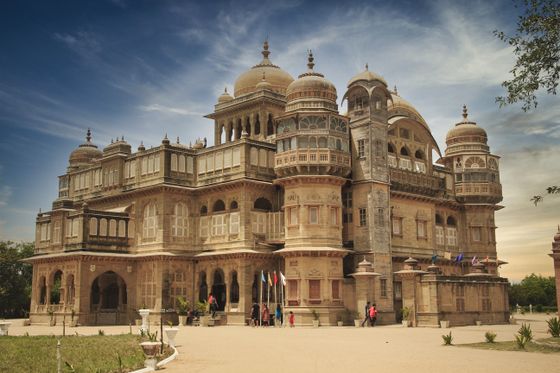
Mandvi Beach (Kutch)
Vijay Vilas Palace
A royal seaside palace near Mandvi beach.

Jamnagar
Lakhota Palace and Museum
A semicircular fort on an island in Ranmal lake, built in the nineteenth century as famine relief so that people had wages. It is a museum now — Saurashtra pottery, an old armoury — reached by a stone causeway.

Bhuj
Aina Mahal
The palace of mirrors, built around 1750 for Rao Lakhpatji of Kutch. His master craftsman Ram Singh Malam had trained abroad and came back to build in the local idiom but finish it in glass, mirror and tile — the Hall of Mirrors, the Pleasure Hall and the state apartments on the first floor, the durbar and marriage halls above. It is a museum now, and the oddest thing in it is the Europeanerie collection Lakhpatji accumulated: clocks, wares, mechanical toys and European paintings, all shipped into a desert court. It stands beside Prag Mahal in the Darbargadh.

Bhuj
Prag Mahal
Italian Gothic in red sandstone, finished in 1879 and badly shaken by the 2001 earthquake — parts are still unrepaired. The clock tower can be climbed for the view over Bhuj.
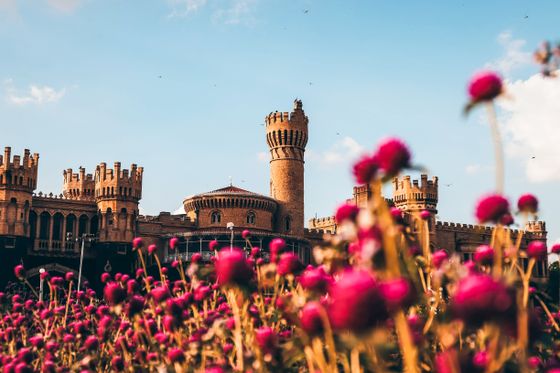
Bengaluru (Bangalore)
Bangalore Palace
A Tudor-style royal palace with grand interiors and grounds.
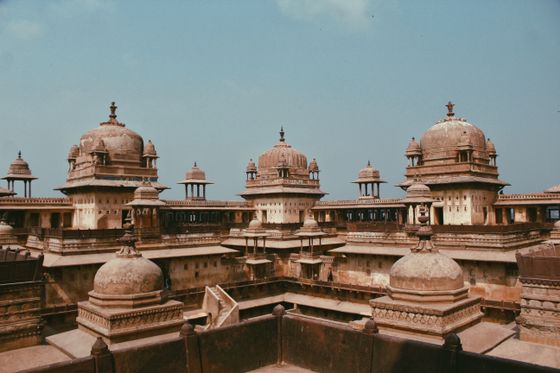
Orchha
Jahangir Mahal
Built for a single visit by Jahangir, who is said to have stayed one night in it. Three storeys of chambers and terraces around a courtyard, and you can walk almost all of it unsupervised, which is rare for a building this size.

Mysuru (Mysore Palace)
Mysore Palace (Amba Vilas)
The royal palace: three storeys of carved mahogany ceilings, stained-glass pavilions and museum rooms of rare weapons.
.jpg/960px-Jai_Vilas_Palace_(_Scindia_Palace).jpg)
Gwalior
Jai Vilas Palace
A 19th-century Scindia palace and museum famed for its durbar hall.
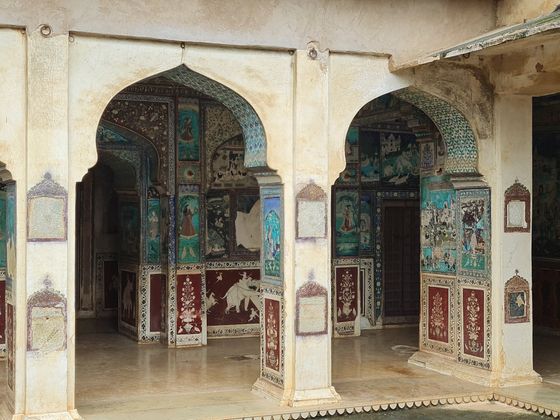
Bundi
Bundi Palace & Chitrashala
The Chitrashala is an open courtyard gallery of Bundi-school murals, mostly Krishna scenes, in blue and green. It has its own entrance and is often unattended. The palace above is largely unrestored and overgrown.

Gondal
Naulakha Palace
The oldest surviving palace in Gondal, dating to 1748 and the reign of Haloji Sagramji, inside the Darbargadh fort complex. The name means nine lakh — what it cost to build. Carved jharokha balconies, a pillared courtyard, delicately cut arches and a spiral staircase that is the thing most people photograph. The durbar hall is lit by chandeliers and still holds gilt wooden furniture, antique mirrors and stuffed panthers, which age badly as a display. The private museum keeps the silver caskets sent to Maharaja Bhagwat Sinhji for his silver jubilee.
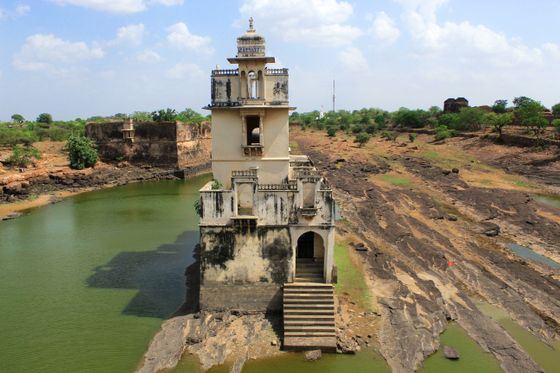
Chittorgarh Fort
Padmini Palace
The lakeside palace built for Queen Padmini, its white walls standing within a moat of water.

Udaipur
City Palace
The largest palace complex in Rajasthan, built over nearly four hundred years by successive Mewar rulers. Udai Singh II began it in 1553, when he moved his capital from Chittor to the new city of Udaipur, and every ruler after him added to it — which is why it reads as a run of connected palaces rather than one building. It stands on a ridge on the east bank of Lake Pichola, so the courtyards look down onto the water and across to the island palaces. Glass and mirror work, mosaic courtyards and the Mewar collection are inside; boats to Jag Mandir leave from below it.
_-_img_01.jpg/960px-East_facade_Hawa_Mahal_Jaipur_from_ground_level_(July_2022)_-_img_01.jpg)
Jaipur
Hawa Mahal
Built in 1799 by Sawai Pratap Singh in red and pink sandstone, on the edge of the City Palace and joined to the zenana, the women's quarters. Its nine hundred and fifty-three lattice windows — jharokhas — let the women of the household watch processions in the street below without being seen, and the honeycomb of openings pulls air through the building, which is what keeps it bearable in a Jaipur summer. The famous view is from outside, facing east: go before nine, while the sun is on the front. Inside it is narrow ramps and small chambers, and much less than the facade promises.

Vadodara
Laxmi Vilas Palace
Commissioned in 1878 by Sayajirao Gaekwad III and finished in 1890 to designs by the British architects Charles Mant and Robert Chisholm, named for Sayajirao's first wife Lakshmibai. The grounds run to more than five hundred acres, which makes it the largest private residence in the world, and it is still the home of the Gaekwad family. The style is Indo-Saracenic: Indo-Islamic massing with Renaissance detail. It cost six million rupees, and had indoor lifts and its own telephone exchange when it opened. Part of it is open to visitors; the rest is a house.

Telangana
Chowmahalla Palace
The Asaf Jahis ran a state from here, and the building still belongs to the family even though it now works as a museum. Nizam Ali Khan Asaf Jah II began the present palace in 1769 on ground that already carried an older Qutb Shahi and Asaf Jahi residence, and ordered four palaces built, which is where the name comes from: chār mahal, four palaces. It sits close to Charminar, so it pairs naturally with an old-city walk rather than needing a day of its own. Expect a court's collection, not a ruin.

Hyderabad, Telangana
Falaknuma Palace

Haryana
Firoz Shah palace complex
Firoz Shah Tughlaq founded this fort city in 1354 CE and took credit for taming a wasteland; the archaeology says otherwise — he built on a mound occupied since the Sindhu-Saraswati Valley Civilisation and the Vedic period, beside a trade road already cut and repaired centuries before him. Inside the rampart are the palace complex and the Lat-ki-Masjid, which has an Ashokan pillar standing in it; Gujari Mahal and the Charbagh garden sit outside the wall. The ASI maintains the site. Go for the pillar and the layers underfoot, not for grandeur.

Jabalpur, Madhya Pradesh
Madan Mahal Fort

Chhattisgarh
Madwa Mahal Temple
A kilometre from Bhoramdeo, and most people drive straight past. This is a Shiva temple raised by the Phani Nagavanshi Gond king Ramchandra Dev, now a state protected monument. It sits close enough to Bhoramdeo that skipping it takes more deliberate effort than stopping does, and the only real obstacle is that nobody tells you it is there.

Jammu, Jammu & Kashmir
Mubarak Mandi Palace
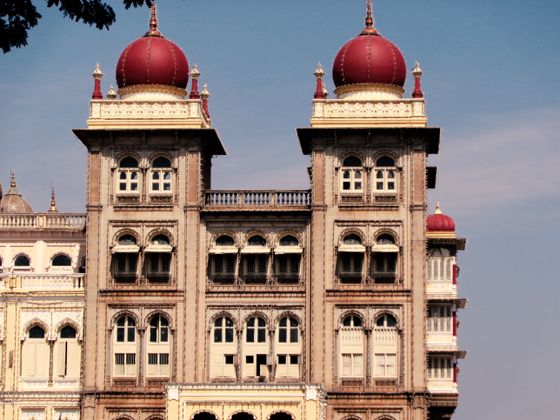
Karnataka
Mysuru (Mysore Palace)
Mysuru is a small, orderly, easy city, and it has the one palace in India that is worth seeing lit up. Mysore Palace switches its exterior lights on for a short window on Sunday evenings and through Dasara — around a hundred thousand bulbs on the outline of the building. Check the current timings locally, because they change, and be there before it happens rather than after. Inside, the Durbar Hall and the marriage pavilion are the rooms to slow down in. Photography is not allowed in the interior and shoes come off at the entrance. Chamundi Hill above the city is the standard sunset trip. The steps up — around a thousand of them — are a better way to arrive than the road, and the Nandi bull two-thirds of the way up is the reason to walk rather than drive. Devaraja Market is the working market: flowers by the kilo, sandalwood, bananas in a dozen varieties. Go in the morning while it is being restocked. Dasara in September or October is the city at full volume, with a caparisoned elephant procession. It is also when every room is booked. October to February otherwise.

Neemrana, Rajasthan
Neemrana Fort Palace

Uttar Pradesh
Panch Mahal, Fatehpur Sikri
Akbar's five-level pavilion at Fatehpur Sikri is all columns and no walls: 176 of them, each carved differently, thinning from 84 on the ground floor to four holding up a chhattri at the top. Jaali screens once filled the gaps, so the women of the neighbouring zenana could take the breeze and watch the Sikri fortifications and the town below without being seen. The screens are gone, so the view now comes unfiltered. The pool in front, the Anoop Talab, once held water and was the setting for music.

Tripura
Pushbanta Palace
This was a working government building rather than a sight until recently. Birendra Kishore Manikya built it in 1917, and it served as Tripura's Raj Bhavan until 2018, when that moved elsewhere. It is now being developed as a national-level cultural museum, which means what you can actually get inside depends on how far the conversion has gone — ask locally before you make the trip rather than turning up and hoping. You will also hear it called Kunjaban Palace.

Chamba, Himachal Pradesh
Rang Mahal (Chamba Fort Palace)

Shey, Leh & Ladakh
Shey Palace

Stok, Leh & Ladakh
Stok Palace

Sikkim
Tsuklakhang Palace
Sikkim's kings were crowned in this chapel and married in it, and it is still the main centre of prayer in Gangtok rather than a preserved royal relic. An assembly hall sits at the centre, with altars carrying Buddha, bodhisattvas and tantric deities, and a large store of Buddhist scriptures. Two dates give the place its character: Pang Lhabsol in mid-September, held in honour of Khangchendzonga, and Kagyad in early December. Time your visit to one of them if you can. On any other day it is a quiet hall and a short stop, not an afternoon.

Tripura
Ujjayanta Palace (Agartala)
Ujjayanta Palace in Agartala is the former royal residence of the princely rulers of Tripura and today the state museum. Built in the early 20th century in a grand Indo-Saracenic style, it stands amid Mughal-style gardens and pools, and its collections cover the culture, history and communities of the northeast.