
Rock-cut Caves
Heritage
Ajanta, Ellora, Elephanta and the lesser-known basalt excavations around them.
21 places
Kamakhya Temple
Inner Cave Sanctum
The natural subterranean stone fissure representing the Goddess, continuously fed by a sacred underground spring.
Ajanta Caves
Cave 1 (Padmapani Fresco)
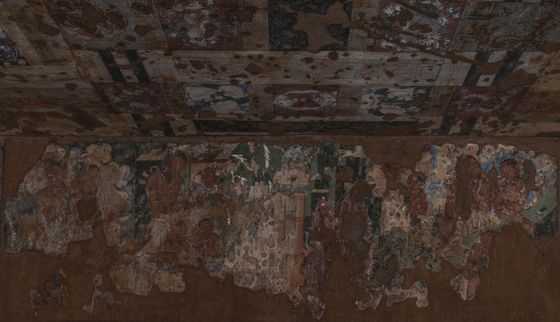
A grand Mahayana vihara cave housing the globally celebrated, masterpiece wall painting of Bodhisattva Padmapani holding a blue lotus.
Ajanta Caves
Cave 26 (Mahaparinirvana)
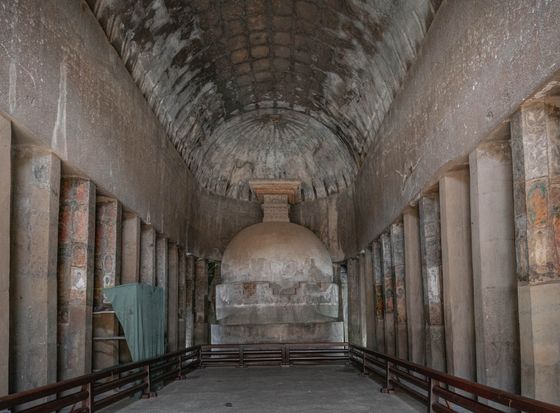
A chaitya hall with a seven-metre reclining Buddha cut along the left wall at the moment of death. Easy to walk past — the sculpture sits back in the aisle, not on the axis.
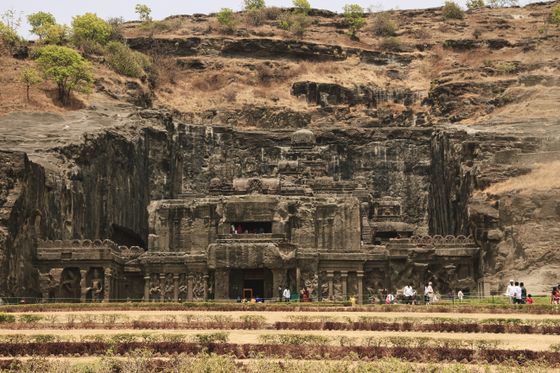
Ellora Caves
Kailash Temple (Cave 16)
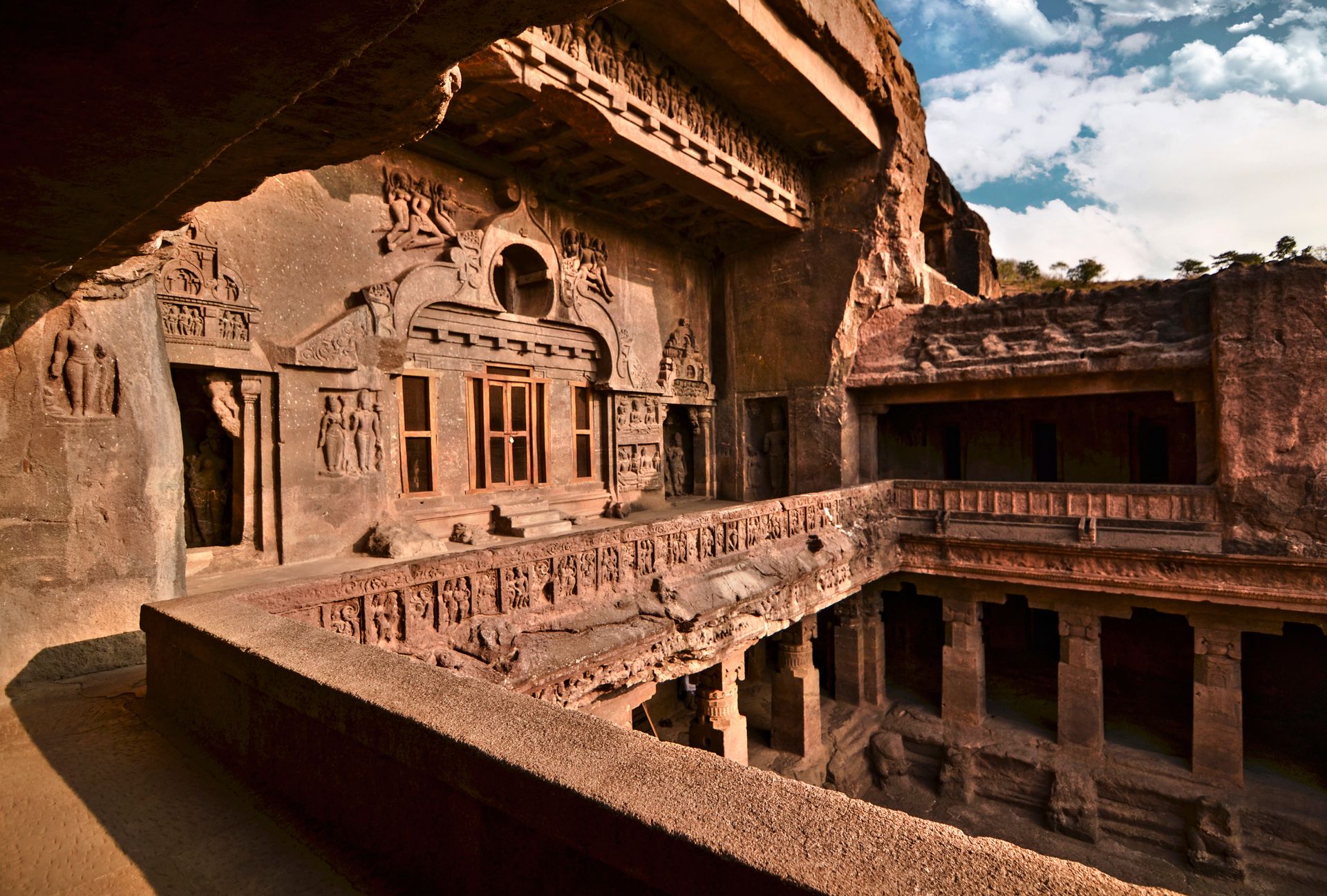
Cut downwards out of one piece of hillside in the eighth century until a complete two-storey temple stood clear of the rock — nothing was added, only stone taken away. Ellora closes on Tuesdays. Walk up the side path for the view down into it.
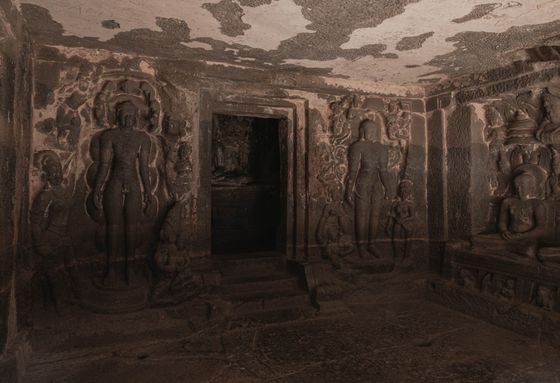
Ellora Caves
Vishwakarma Cave (Cave 10)
The only chaitya hall at Ellora, and its vaulted ceiling is carved in stone to imitate wooden ribs, which is where the carpenter's-cave name comes from. Stand at the back and the sound changes noticeably.
Maharashtra
Ajanta Caves
Maharashtra
Ellora Caves
Madhya Pradesh
Rock Shelters of Bhimbetka
Gharapuri (Elephanta Island), Maharashtra
Elephanta Caves

Badami, Karnataka
Badami Fort

Bihar
Barabar Caves
These are the oldest surviving rock-cut caves in India, 24 km north of Gaya in Jehanabad district, cut under the Mauryas for ascetics of the Ajivika sect. Seven chambers across two hills, four at Barabar and three at Nagarjuni about 1.6 km further on, so plan for the walk between them. The one to see is Lomas Rishi, whose carved doorway is the earliest surviving chaitya arch in India, a stone copy of a building made of wood. Ashoka appears in the inscriptions as King Piyadasi. Inside, the chambers are bare; all the carving is on that entrance.

Chhattisgarh
Jogimara and Sitabenga Caves
Two caves in the north side of the Ramgarh hills, partly natural and partly cut, dated somewhere between the 3rd and 1st centuries BCE. What makes them matter is written on the rock: Brahmi inscriptions in Magadhi that are not religious at all, and painted frescoes among the oldest surviving in Asia. Scholars still argue over Sitabenga, the oldest performance theatre on the subcontinent or a rest house on a trade route, and over the Jogimara inscription, read either as lovers' graffiti or as a dancer and a painter recording their joint work. Regional tradition puts Rama, Sita and Lakshmana here at the start of the exile.

Chhattisgarh
Kotumsar Cave
Check the season before you set out. The cave floods through the monsoon, typically mid-June to mid-October or early November, and the authorities close it while the water is high, so turn up in that window and you will see the gate and nothing else. Outside it you get a limestone tunnel of about 200 metres inside Kanger Valley National Park, with lateral and downward passages leading off the main line and pools that sit there permanently. It is the longest cave on the subcontinent, close to the bank of the Kanger river near Jagdalpur, in the forest tract old texts call Dandakaranya.
Bihar
Lomas Rishi Cave
Whoever cut this doorway in the 3rd century BC was reproducing in stone a hut built of wood and thatch. The result is the earliest chandrashala, or chaitya arch, to survive in India, and scholars trace the great chaitya halls of the western Deccan back to this one facade. Who the cave was made for is less settled than it sounds: the other Barabar caves carry dedications to the Ajivikas and this one carries none, so it may have been Ashoka's gift to the Buddhists instead. Behind the entrance is a large rectangular hall, entered from the side. The doorway is the visit.

Andhra Pradesh
Mogalrajapuram Caves
Five groups of rock-cut caves, scattered across different parts of Vijayawada rather than gathered at one site, which is the main practical difficulty in seeing them. They are Shiva caves, cut around the 7th century under the Eastern Chalukyas or the Vishnukundins, and they are small and plain buildings. The interest lies in the carving, which is more sophisticated than that of the earlier Akkanna Madanna caves: a Nataraja, a Ganesh, an Ardhanarisvara. If you are only making one stop, make it Cave II, the most developed of the five. A short visit by any measure.

Bihar
Saptaparni Cave
There is almost nothing to look at when you get up there, and it hardly matters. This cave set into a hillside two kilometres southwest of Rajgir is where a few hundred monks are believed to have held the first Buddhist council after the Buddha died. He never wrote his teachings down, so what came out of this room is the reason a canon exists at all: Ananda was appointed to recite the sermons from memory, Upali the rules for monks. The walk up is the visit, and the place earns it.

Meghalaya
Siju Cave
Its English name is Bat Cave, and tens of thousands of them live inside, which will be either the reason you go or the reason you do not. Siju Dobakkol is a limestone cave in the Garo Hills, near Napak Lake and the Simsang River game reserve, and it is one of the most thoroughly researched caves in the subcontinent, which is unusual company for somewhere this far off the standard itinerary. The stalactite and stalagmite formations are what most visitors come for. Bring a torch you actually trust.

Bihar
Sitamarhi Cave
One chamber hewn into a single hemispherical block of granite, 20 km southwest of Rajgir and 10 km southwest of Hisua. It is Mauryan, and it has the structure and the mirror polish of the Barabar caves along with the same trapezoidal doorway, but not one of their inscriptions. It is also markedly smaller, 4.91 by 3.43 metres with the ceiling 2.01 m overhead, so two people fill it and there is nothing to read on the walls. Worth the detour if you are already doing Barabar, or Son Bhandar at Rajgir, with which it is often grouped. Not worth a trip of its own.

Bihar
Son Bhandar Caves
Two Jain caves cut into the base of the Vaibhar Hills at Rajgir, easy to reach and quickly seen. The main one is a rectangle with a trapezoidal doorway and a vaulted ceiling, borrowed straight from Barabar, but the rock is softer and the polish and finish are visibly poorer. That is honest information: if you have already been to Barabar this will read as a lesser copy. A dedicatory inscription in the larger cave is in 4th-century Gupta script, which is how the usual date is arrived at, though some scholars push the caves back to Mauryan times.

Odisha
Udayagiri & Khandagiri Caves
Udayagiri and Khandagiri are twin hills on the outskirts of Bhubaneswar honeycombed with rock-cut caves carved as dwellings for Jain monks, dating back to the 2nd century BCE. Udayagiri's Rani Gumpha (Queen's Cave) is the most elaborate, while the hills together carry the historically important Hathigumpha inscription of the Kalinga king Kharavela. As one of India's oldest surviving examples of Jain rock-cut architecture, the site draws well over a million visitors a year and is among Odisha's most-visited heritage attractions.

Madhya Pradesh
Udayagiri Caves
Twenty caves are cut into a hillside near Vidisha, and one relief alone justifies the stop: Vishnu as Varaha the man-boar, lifting the earth from the water with Bhudevi clinging to his tusk. The carving spans the early 3rd century to the 5th century CE and includes some of the oldest surviving Hindu iconography in India. Nineteen caves are Hindu, with inscriptions from 401 CE; the one Jain cave carries an inscription from 425. This is the only site that can be tied by its own inscriptions to a Gupta monarch. Rock shelters, petroglyphs, water systems and fortifications are scattered around the hill.
.JPG/960px-Aurangabad_-_Ajanta_Caves_(21).JPG)


