

Tombs & Mausoleums
Heritage
Mughal garden tombs, Deccan gumbads and the one everybody comes for.
16 places
Agra, Uttar Pradesh
Taj Mahal
Taj Mahal (Agra)
Main Tomb Chamber
The high-ceilinged marble chamber housing the cenotaphs of Mumtaz Mahal and Shah Jahan, enclosed by a finely carved lattice screen.

Junagadh
Mahabat Maqbara Complex
Two mausoleums side by side, finished in 1892 and 1896: one for Mahabat Khan II, Nawab of Junagadh, the other for his minister Bahauddin Hussain Bhar. What makes them worth the detour is the mix — Indo-Islamic domes and arches carrying Gothic windows, silver doors, and four minarets with staircases winding up the outside of them, which is close to unique in India. They have been poorly maintained for years and are often locked; the exterior is the visit, and it is enough. Late afternoon light suits the stonework better than midday.
Delhi, Delhi
Humayun's Tomb
Fatehpur Sikri
Tomb of Salim Chishti
An exquisite white-marble Sufi shrine in the mosque courtyard.

Orchha
Betwa Cenotaphs (Chhatris)
Cenotaphs to the Bundela rulers standing in a row along the Betwa. Best at the end of the day, seen from the far bank, where nobody charges you anything.

Maharashtra
Bibi Ka Maqbara (Aurangabad)
Bibi Ka Maqbara in Aurangabad (Chhatrapati Sambhajinagar) is a grand Mughal mausoleum built in the 1660s to 1670s for Dilras Banu Begum, the wife of Emperor Aurangzeb. Closely modelled on the Taj Mahal, its marble and stucco dome earned it the nickname the Taj of the Deccan.

Karnataka
Gol Gumbaz (Vijayapura)
Gol Gumbaz in Vijayapura (Bijapur) is the mausoleum of Sultan Mohammed Adil Shah, completed in 1656. Crowned by one of the largest masonry domes in the world, it is famous for its Whispering Gallery, where even a soft sound is carried clearly across the vast circular hall and echoes many times over.

Haryana
Khwaja Khizr Tomb
Ibrahim Lodi built this tomb at Jatwara in Sonipat between 1522 and 1524 for Khwaja Khizr, whose father Darya Khan Sharwani was an influential noble in his own court. It was the last thing the Lodi dynasty put up. The material is the interesting part — red sandstone over Lakhauri brick and kankar block — and a Persian inscription inside is what tells us who is buried here. It is small and it is five hundred years old. Half an hour, if Sonipat is on your way.

Telangana
Paigah Tombs
The man who paid for this necropolis, Nawab Sir Khursheed Jah Bahadur, made sure his own family got the best of it. Every arch here belongs to the Paigah nobility, statesmen, generals and philanthropists who stayed loyal to the Nizams, but only his family's arch is larger than the rest, and only their tomb holds the double maqbara called Mahajar. Look for the stucco on the tomb of Lateefunnisa Begum Saheba, his grandmother; nothing else in the complex matches it. The laid mosaic tilework is the reason to come, and it rewards slow walking.

Telangana
Qutb Shahi tombs
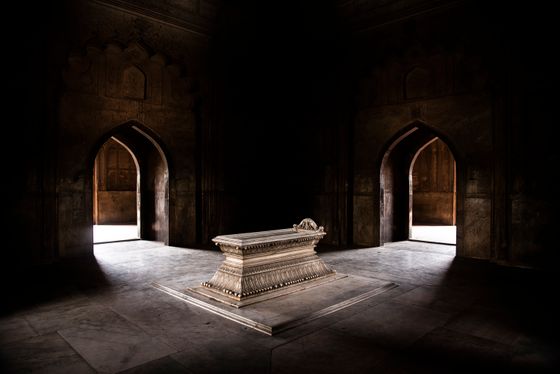
Every dome here was once overlaid with blue and green tile; a few pieces are all that survive, and knowing that changes how the bare stone reads. The Qutb Shahi kings built their tombs and mosques together in the Ibrahim Bagh garden precinct, close to Golconda Fort, the smaller galleries rising a single storey and the larger ones two. The sarcophagus you stand over is a marker, not the grave: the burial vault sits in a crypt below. This is a garden as much as a monument, and it rewards an early start.

Delhi
Safdarjung's Tomb (Delhi)
Safdarjung's Tomb is a garden-tomb built around 1754 for Safdarjung, the powerful Nawab of Awadh and a prime minister of the Mughal empire. Set in a formal charbagh garden, its red-and-buff sandstone dome and symmetrical layout make it one of the last great monuments of the Mughal era.

Telangana
Saidani Ma Tomb
The grave itself is sealed underground at the base of the dome and not open to the public, so what is on offer is the shell above it: elaborate stucco, fretwork jali screens, Mughal and Qutb Shahi habits sitting in one building. Nawab Abdul Haq Diler Jung, among the richest nobles of his day and later director of the Nizam's State Railways, put it up in 1883 for his mother. It stands near Tank Bund on the banks of Hussain Sagar, which makes it an easy stop rather than a destination. Diler Jung is buried here too.

Uttar Pradesh
Taj Mahal (Agra)
The Taj Mahal stands in white marble on the southern bank of the Yamuna River at Agra. The Mughal Emperor Shah Jahan commissioned it in 1632 to house the tomb of his favourite wife, Mumtaz Mahal, and nothing else the Mughals built comes as close to perfection. The whole structure is symmetrical, and the geometry is exact. You come in through a grand red sandstone gateway, then across a formal geometric garden divided by long reflecting pools. The mausoleum sits on a massive marble plinth, a central dome above it and four identical minarets at the corners. The white marble is intricately inlaid with semi-precious stones, and it changes colour through the day — soft pink at dawn, brilliant white under noon skies, shimmering gold under a full moon.

Uttar Pradesh
Tomb of I'timād-ud-Daulah
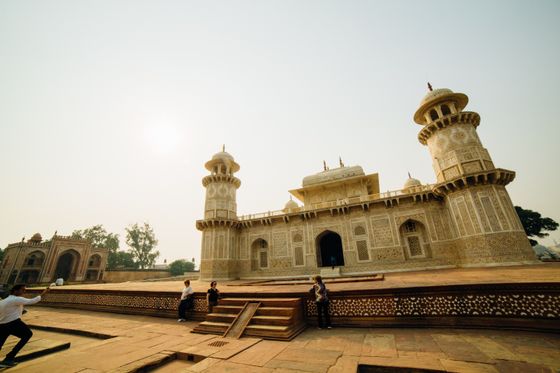
Nur Jahan built this in Agra for her father, Mirza Ghiyas Beg, a Persian amir in exile who was given the title I'timad-ud-Daulah, pillar of the state. It went up between 1622 and 1628, at the point where Mughal building turns from red sandstone with marble decoration into white marble and pietra dura inlay: the language the Taj Mahal would later speak in full. People call it the Baby Taj, which undersells it. Small enough to see properly in an hour, with gardens and outbuildings around it, and far quieter than the tomb it prefigured.

Bihar
Tomb of Sher Shah Suri
The tomb was finished on 16 August 1545, about three months after the man who commissioned it for himself had died. Sher Shah Suri founded the Sur Empire, and his mausoleum was the largest in India when it was completed: a three-storey sandstone octagon under a broad dome, chhatris at every edge, standing on a square plinth in the middle of an artificial lake and reached by a causeway. The walk out is the experience. The western wall is the only side with no entrance, being the qibla, and its prayer niche holds the best carving and tilework here.
