

Grand Old Hill Towns
Hill Stations
Ridge-top promenades, mall roads, toy trains and hotels that have taken guests for a century.
10 places
When to go. March to June, and again October to November. Avoid the mid-May to mid-June peak if crowds bother you: Shimla and Ooty run at full capacity and the roads in show it.

Himachal Pradesh
Shimla
Shimla, the former summer capital of British India, is one of the country's most popular hill stations. Its colonial Mall Road, the Ridge, Christ Church and the UNESCO-listed Kalka-Shimla toy train make it a perennial favourite in the Himalayan foothills.
Tamil Nadu
Ooty (Udhagamandalam)
Ooty sits at 2,240 metres and was built by the British as a hot-weather escape, which is still exactly what it is used for — and why April and May are the months to avoid, when the plains empty into it. The Nilgiri Mountain Railway is the best thing in the district. It climbs from Mettupalayam on a rack-and-pinion section, takes about five hours, and is UNESCO-listed. Book ahead in season or take the ordinary carriage, which is fine. Doddabetta, the highest point in the Nilgiris, is ten kilometres out and usually inside cloud by afternoon. The Botanical Garden dates from 1848 and has a fossil trunk around twenty million years old in it. The lake is man-made and rented out by the hour. Tea here is grown for volume rather than for named estates, and the roadside shops sell a great deal of flavoured dust. Buy from an estate if you care about it. September to November, and January to March.
Uttarakhand
Mussoorie
Famously nicknamed the 'Queen of the Hills', this historic colonial-era hill station looks out over the Doon Valley and Shivalik ranges. Mussoorie is a legendary hill station at an altitude of roughly 2,009 metres in the Dehradun district of Uttarakhand. It stands as one of India's oldest and most commercialised mountain getaways, established during the British Raj.
West Bengal
Darjeeling
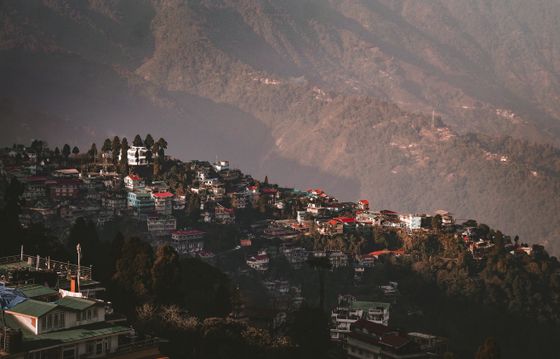
Darjeeling sits at about 2,042 metres on a steep mountain ridge of the Lesser Himalayas in northern West Bengal, under the snow mass of Mount Kanchenjunga, the third-highest peak on earth. The colonial-era tea estates run in loops down the slopes below the town. Chowrasta Mall, a pedestrian square, is the commercial heart of the place — vintage bookshops, old tea lounges and handicraft stalls around it. The town is built in layers: British colonial masonry, Tibetan Buddhist monastic architecture, and the narrow-gauge Darjeeling Himalayan Railway, the toy train, threading between them.
Uttarakhand
Nainital
Nainital is a charming Kumaon hill station built around the emerald, eye-shaped Naini Lake. With its boating, the crowded Mall Road, cable car to Snow View and surrounding viewpoints, it is one of North India's most beloved lake resorts.

Maharashtra
Mahabaleshwar
Mahabaleshwar sits at 1,353 metres on a broad plateau ridge of the Sahyadri range in Satara district, the highest and most extensive hill resort in Maharashtra, with dense evergreen forest, steep river canyons and terraced fields on every side. The town has kept its old colonial character, and the viewpoints step out over the valley in tiers — Arthur's Seat is the one to walk to. Venna Lake, at the centre, is artificial. The soil around here is famously fertile and grows fruit on a commercial scale, including nearly 85 percent of the country's strawberries.
Maharashtra
Matheran
Matheran bans motor vehicles inside the town, which makes it the quietest place within two hours of Mumbai and the only hill station in Asia to enforce that. Cars stop at Dasturi Naka and you walk the last stretch in, or take a hand-pulled rickshaw or a horse. The other way up is the narrow-gauge train from Neral, which takes a couple of hours to cover about twenty kilometres and is worth doing once, when it is running. Everything here is a walk on red laterite paths through forest to a numbered viewpoint — Louisa for Prabal fort, Panorama for the sunrise, Echo for the obvious. Wear shoes you do not mind ruining: the dust is iron-red and gets into everything. Come on a weekday. At weekends the horse traffic on the paths is heavier than the foot traffic. October to May. The monsoon closes the train and turns the paths to slurry.
Tamil Nadu
Kodaikanal
Kodaikanal sits at 2,133 metres on a plateau ridge of the Palani Hills in Dindigul district, ringed by dense pine forest, rugged granite cliffs and waterfalls. It is the 'Gift of the Forest', and one of South India's mountain resorts. The town gathers round the star-shaped Kodaikanal Lake, where people cycle, ride horses and take boats out. Beyond the cool mountain air, what is good here is the old institutional architecture, the wide pine-fringed walks such as Coaker's Walk, and the sheer drops at the plateau's edge looking out over the rolling lowlands.
Rajasthan
Mount Abu
Rajasthan's only hill station, at 1,220 metres on a granite plateau in the Aravallis, and it exists largely because Gujarati and Rajasthani families need somewhere cool in May. Dilwara is the reason to make the climb: five Jain temples, twelfth to sixteenth century, in white marble carved thin enough in the ceilings that light comes through. No cameras inside, and non-Jains are admitted only from midday — plan the day around that, because most people get it wrong and lose a morning. Nakki Lake in the middle of town is pedal boats and crowds. Guru Shikhar, the highest point in the Aravallis, is a short drive and a flight of steps. Sunset Point is exactly as busy as it sounds. November to February is cool and can drop below freezing at night — the only place in Rajasthan where that happens. Busiest in May and June, and over Diwali.
Himachal Pradesh
Dalhousie
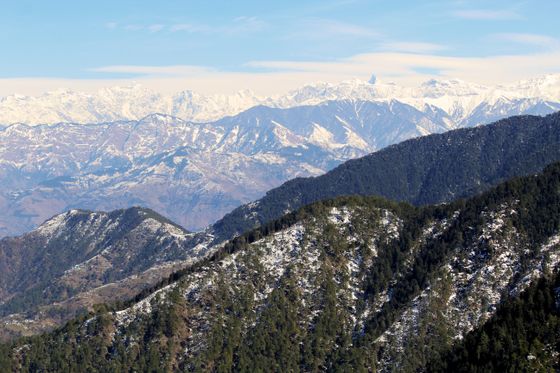
Dalhousie is a peaceful colonial-era hill station built across five distinct hills of the Dhauladhar mountain range, sitting at an altitude of 1,970 metres. Established in the mid-19th century under the British Raj, the town has systematically preserved its old-world charm, characterised by wide pine-fringed walking loops, traditional stone mansions, and vintage Scottish architecture. Tourism in Dalhousie centres around the historic public squares of Gandhi Chowk and Subhash Chowk, linked by wooded walking paths like Garam Sadak. The town is the quiet alternative to the commercial hill stations, with views of the winding Ravi River and the distant snow-covered peaks of the inner Himalayas.


