

Buddhist & Jain Circuits
Spiritual & Pilgrimage
Monasteries, stupas, viharas and the hilltop Jain complexes of the west and south.
44 places
Bodh Gaya
Great Buddha Statue
An 80-foot seated Buddha statue, a landmark of the town.

Arunachal Pradesh
Tawang Monastery
India's largest Buddhist monastery holds the slope above the Tawang Chu valley, close to both the Chinese and Bhutanese borders. It is three storeys high, ringed by a compound wall 282 metres long, with 65 residential buildings inside, which makes it closer to a walled town than a single hall and worth walking properly rather than photographing from the gate. Merak Lama Lodre Gyatso founded it in 1680-81 at the wish of the fifth Dalai Lama; it follows the Gelug school and kept a long association with Drepung in Lhasa. The library holds old Kangyur and Tengyur scriptures.
Key Monastery
Monastery Kitchen
The traditional wood-fired kitchen where friendly lamas prepare hot butter tea and local barley meals for visitors.
Kushinagar
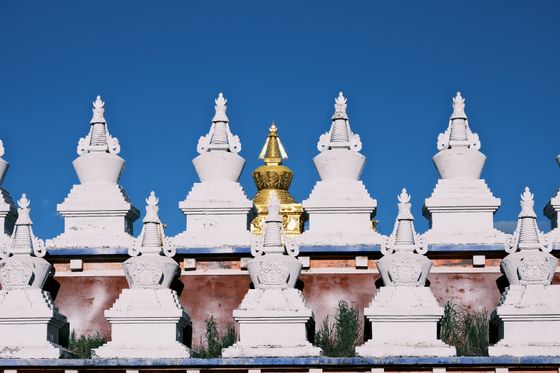
Ramabhar Stupa
The large stupa marking the site of the Buddha's cremation.
.jpg/960px-Mulagandha_Kuti_Vihara%2C_Sarnath_(13458).jpg)
Sarnath
Mulagandha Kuti Vihara
Built in 1931, with wall paintings by the Japanese artist Kosetsu Nosu that took him years to finish. The Bodhi tree outside was grown from a cutting of the one at Anuradhapura, which came from Bodh Gaya. The relics are shown once a year.

Sarnath
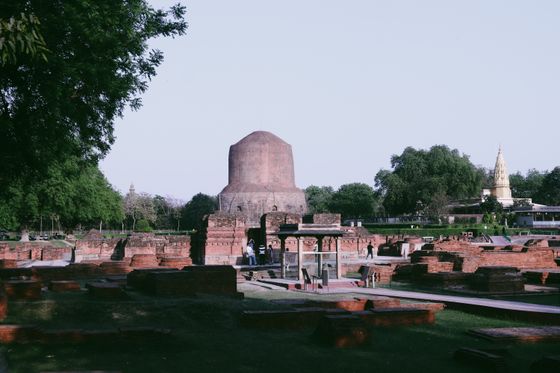
Dhamek Stupa
A massive 5th-century stupa marking the site of the Buddha's first sermon.
Sarnath
Sarnath Museum
Home to the original Ashoka Lion Capital, India's national emblem.

Girnar (Jain Temples)
Girnar Jain Temple Group
A cluster of Jain temples partway up Girnar, the ancient hill above Junagadh, and one of the great Svetambara pilgrimages — a Mahatirth. Tradition holds that Neminath, the twenty-second Tirthankara, attained omniscience here and later nirvana at the highest peak, along with five hundred and thirty-three other enlightened sages; the Kalpa Sutra and the Uttaradhyayana Sutra both describe it. The temples sit several thousand steps above the base. The climb is the point and it is a real one — start before dawn, or take the ropeway up and walk down.

Bodh Gaya
Mahabodhi Temple & Bodhi Tree
The UNESCO temple beside the tree under which the Buddha was enlightened.
Sarnath
Sarnath Archaeological Museum
India's oldest site museum gallery housing the original 3rd-century BCE Ashokan Lion Capital and masterfully carved sandstone Buddha statues.

Sanchi
The Great Stupa
India's oldest stone stupa, famed for its carved gateways.
.jpg/960px-Archaeological_site_of_Sarnath%2C_Varanasi%2C_Uttar_Pradesh%2C_India_(2015).jpg)
Uttar Pradesh
Sarnath
Sarnath, near Varanasi, is where the Buddha delivered his first sermon after enlightenment, setting in motion the wheel of dharma. The towering Dhamek Stupa, ancient monastery ruins and an excellent archaeological museum make it a cornerstone of the Buddhist circuit.

Girnar Hills
Neminath Jain Temples
A walled cluster of marble Jain temples around the 3,500-step mark, built between the twelfth and fifteenth centuries. Neminath's temple at the centre is the main one, and the courtyards are the first flat ground on the climb, so most people rest here.
.jpg/960px-Rajgir_-_046_Side_View_(9242059259).jpg)
Rajgir
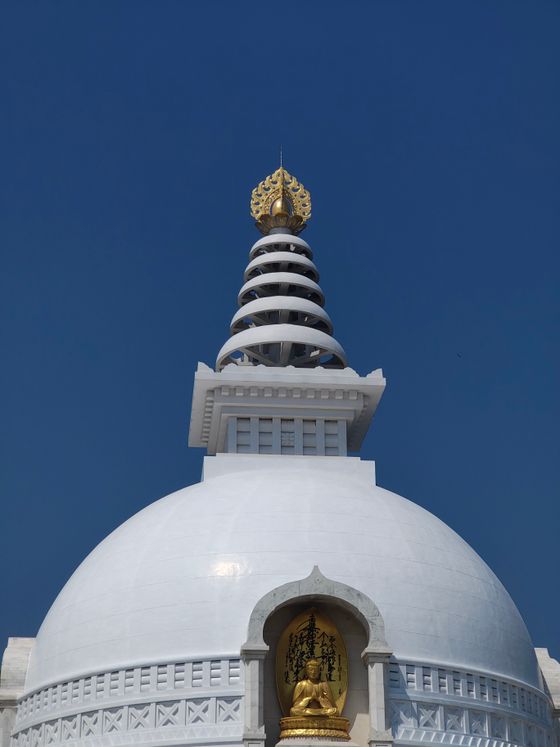
Vishwa Shanti Stupa
A white peace pagoda atop a hill, reached by a ropeway.

Palitana (Shatrunjaya)
Shatrunjaya Temple City
A range of hills above Palitana carrying 865 Jain temples — not one temple with outbuildings but a city of them, built up along the ridge over centuries. Jain tradition holds the site was sanctified when Rishabha, the first Tirthankara, preached from the summit, and that Pundarik Swami, his grandson and chief Ganadhara, attained moksha here. It is among the holiest places in Jainism. Getting up means roughly 3,500 steps and there is no ropeway; pilgrims start before dawn, and nobody stays on the hill overnight, priests included.
Amararama (Amaravati)
Amaravati Stupa
The ruins and museum of a great ancient Buddhist stupa nearby.

Leh & Ladakh
Alchi Monastery
Alchi is unlike any other gompa in Ladakh: it sits low by the Indus rather than on a crag, and its temples preserve some of the finest 11th–12th century Buddhist art in the world. The Kashmiri-style murals of the Sumtsek and Dukhang — thousand-Buddha walls, colossal bodhisattvas painted with miniature scenes on their robes — survive from the era of the great translator Rinchen Zangpo. It is a quiet village of apricot orchards, a living museum of a vanished artistic world.

Bihar
Bodh Gaya
Bodh Gaya is the most sacred site in Buddhism — the place where Prince Siddhartha attained enlightenment under the Bodhi Tree to become the Buddha. The Mahabodhi Temple, a UNESCO World Heritage Site, and monasteries built by Buddhist nations worldwide make it a global pilgrimage centre.

Rajasthan
Dilwara Temples (Mount Abu)
The Dilwara Temples at Mount Abu are a group of five exquisite Jain temples built between the 11th and 13th centuries, known for marble carving cut so thin that the ceilings pass light — ceilings, pillars and panels worked into lace-like detail considered unsurpassed in India.

Nagaland
Dimapur Jain Temple
Built in 1947 on Jain Temple Road, this is Dimapur's Jain temple, with Mahavira as its moolnayak, the primary deity the whole building is arranged around. The SD Jain Samaj Dimapur looks after it. It is a working neighbourhood temple rather than a monument, so keep the visit brief and quiet, and ask before photographing anything inside.

Leh & Ladakh
Diskit Monastery
Diskit is the oldest and largest monastery of the Nubra valley, founded in the 14th century and stacked on a rocky spur above the Shyok river. Its prayer halls hold fierce guardian deities and centuries-old murals, but the landmark is newer: the 32-metre Jampa (Maitreya) Buddha on the hill facing Pakistan, consecrated by the Dalai Lama in 2010, gazing out over the cold-desert dunes of Hunder.

Sikkim
Dubdi Monastery
Dubdi means the retreat, and the three kilometres up out of Yuksom, about an hour on foot, earn the name before you arrive. Established in 1701 and professed to be the oldest monastery in Sikkim, it is also called the Hermit's Cell after Lhatsun Namkha Jigme, one of the three lamas who met at Norbugang and crowned Phuntsog Namgyal the first Chogyal in 1642. It is a small Nyingma house on a hilltop, and the walk is half of what you came for. Take it as the first leg of the circuit that runs on through Norbugang, Pemayangtse, the Rabdentse ruins and Tashiding.

Sikkim
Enchey Monastery
The name means Solitary Monastery, which stopped being accurate a long time ago. The 1909 Nyingma building went up above what was then a small hamlet, and Gangtok has grown around it since. The site was chosen by Lama Drupthob Karpo, a tantric adept credited with flight, who is said to have flown here from Maenam Hill in South Sikkim and put up a small gompa on the spot. Sikkimese belief holds that the protecting deities Khangchendzonga and Yabdean live here and grant what devotees ask for, which is why this place matters in Gangtok households and not only to visitors.

Gujarat
Girnar (Jain Temples)
Girnar, a sacred volcanic massif near Junagadh, is a major pilgrimage for both Jains and Hindus. The arduous climb of roughly 10,000 steps passes a walled cluster of medieval Jain temples partway up, before continuing to Hindu shrines at the higher summits — a full day's climb, and one of the hardest pilgrimages in Gujarat.

Bihar
Great Buddha (Bodh Gaya)
Sixty-one feet of sandstone and red granite, seated in meditation on a lotus in the open air at the end of Temple Street, with the Buddha's ten principal disciples ranged five to a side. The foundation stone went down in 1982, twelve thousand stonemasons worked on it for seven years, and the Dalai Lama consecrated it in 1989. A hollow spiral staircase runs from the ground up to the chest, its walls shelved with 16,300 small bronze Buddhas. It is modern and it means to impress, which after the Mahabodhi complex can feel like a lot. Go anyway, and go inside.
Leh & Ladakh
Hemis Monastery
Hemis belongs to the Drukpa (Dragon) lineage of the Kagyu sect, and it is set back in a mountain canyon on the western bank of the Indus, roughly 45 kilometres south of Leh. It is the largest and wealthiest monastery in Ladakh, and the most influential. The buildings are traditional Tibetan monastic architecture on a large scale: whitewashed stone walls, timber windows painted in fine detail, and wide flagstone courtyards. Below is a museum holding centuries of gold-plated statues, sacred thangkas and old weapons.

Bihar
Jivakarama vihara
Jivaka, royal physician to king Bimbisara, owned a mango orchard below Gijjhakuta hill outside Rajgir, and gave it to the Buddha's sangha along with the monastery he built on it. The Buddha was treated here after Devadatta injured him. What survives is the ground plan: long parallel halls where monks ate and slept together, no private cells and no stupa, which is what makes it look unlike every later vihara. Archaeology puts it at roughly 530 to 400 BCE. It is a short stop unless building plans genuinely interest you.

Himachal Pradesh
Key Monastery
Key Monastery is a thousand-year-old Tibetan Buddhist monastery belonging to the Gelugpa (Yellow Hat) lineage. At 4,166 metres, it sits on a prominent volcanic cone hill overlooking the wide Spiti River valley floor. Located roughly 14 kilometres from Kaza, it stands as the largest monastery, primary spiritual archive, and leading training school for resident Lamas in Spiti Valley. The unique architectural layout of the monastery has evolved over centuries of restructuring, resulting in a tightly stacked, fortress-like profile known as the Pasada style. The close grouping of white-washed mud-brick rooms, multi-tiered chapels, and narrow defensive corridors gives the complex the appearance of a monolithic castle emerging naturally from the mountain slope.
Bihar
Mahabodhi Temple
Buddhists have been coming to this spot for over two thousand years. It marks where the Buddha is said to have reached enlightenment, and it remains the most revered pilgrimage site in the Buddhist world; the tree here is held to descend from the original Bodhi Tree. Most of what stands is 6th-century CE work, brick under stucco, heavily restored since the 19th century. The carved stone railing is replica and the finest early sculpture has moved to the museum beside the temple, so do that too. The Vajrasana inside dates to the 3rd century BCE.

Gujarat
Palitana (Shatrunjaya)
Palitana, in Gujarat's Saurashtra, is one of Jainism's most sacred sites — the Shatrunjaya hill is crowned by an astonishing cluster of over 800 intricately carved marble temples. Pilgrims climb roughly 3,800 steps to reach the summit, where the temple-city gleams in white marble. No one, not even priests, may stay overnight on the sacred hill.

Sikkim
Pemayangtse Monastery
Only the monks here are entitled to be called ta-tshang, monks of pure lineage: celibate, without physical abnormality, and still drawn from among Sikkim's Bhutias. That rule has held since Lama Lhatsun Chempo founded the place in 1647, and it makes this a house with conditions rather than a photo stop. Pemayangtse means Perfect Sublime Lotus, and the monastery still governs every other Nyingma house in Sikkim; its head lama once anointed the Chogyals with holy water. Six kilometres from Gyalshing, and part of the pilgrim circuit that begins with Dubdi at Yuksom. Come early and behave as you would in someone's home.

Sikkim
Phodong Monastery
The murals are the reason to stop, an old collection held in a building that is itself a reconstruction of an early eighteenth-century monastery, which in turn replaced something older. Phodong is one of three the ninth Karmapa founded in Sikkim at the king's invitation, alongside Rumtek and Ralang, and Sidkeong Tulku Namgyal rebuilt it. Around 260 monks live here, so it is a working monastery rather than a monument. Go in quietly. It sits twenty-eight kilometres from Gangtok, so pair it with something else rather than driving out for it alone.

Rajasthan
Ranakpur Jain Temple
The Ranakpur Jain Temple, set in a quiet Aravalli valley, is a 15th-century marble masterpiece dedicated to Adinath, the first Tirthankara. Famed for its forest of 1,444 individually carved marble pillars — no two alike — it stands with Dilwara as the finest marble carving in Rajasthan.

Sikkim
Rumtek Monastery
Rumtek is the largest monastery in Sikkim and the seat-in-exile of the Karmapa, head of the Karma Kagyu (Black Hat) lineage. Rebuilt in the 1960s by the 16th Karmapa as a faithful copy of Tibet's Tsurphu monastery, it holds the Golden Stupa with his relics, a monastic college, and treasures of the lineage. Ritual dances, deep-horn ensembles and the view back across the valley to Gangtok make it the centrepiece of any Sikkim circuit.

Sikkim
Sanga Choeling Monastery
Seventeenth-century, and among the oldest monasteries around Pelling, but the climb is what you will remember: four kilometres of steep track through thick forest to a ridge top, with no way to shorten it. Lama Lhatsun Chempo founded it, and the name means the island of the Guhyamantra teachings, which is to say Vajrayana. Pilgrims take it as part of the circuit running through Pemayangtse, seven kilometres off, along with the Rabdentse ruins, Khecheopalri Lake, Norbugang Chorten, Dubdi Monastery, Yuksom and Tashiding. Start early. The track is unkind in the middle of the day.

Leh & Ladakh
Shanti Stupa
The white dome above Chanspa is newer than it looks. A Japanese monk, Gyomyo Nakamura, built it in 1991, and the 14th Dalai Lama enshrined relics of the Buddha in its base. The hilltop puts the surrounding landscape below you, which is why people climb it whatever their feelings about stupas. Go at either end of the day, when the light is doing something. And give yourself a day or two in Leh first: the climb is short, but you are doing it at Ladakhi altitude.

Gujarat
Shatrunjaya Hill
Shatrunjaya Hill rises above the Shatrunjaya River near Palitana town in Bhavnagar district, and no other mountain in the world carries anything like what stands on top of it: a fortified complex of more than 860 carved marble temples, built over the course of a millennium. The Jain community holds the whole hill to be sacred ground, and no vehicle goes past the base — pilgrims and travellers climb roughly 3,500 stone steps to reach the temples at the summit.

Leh & Ladakh
Shey Monastery
Shey was the summer capital of Ladakh, and the site still reads that way: the 10th-century palace of Lhachen Palgyigon stands ruined on the hillock, with the later palace and monastery, raised in 1655 on Deldan Namgyal's instructions in memory of his father Sengge Namgyal, sitting below it. The reason to walk up is indoors — a seated Shakyamuni Buddha in copper, gilded with gold, the second largest statue of its kind in Ladakh. It stands on the Leh–Manali road 15 km south of Leh, so fold it into a day already going that way rather than driving out for it alone.

Karnataka
Shravanabelagola
Shravanabelagola is among the most important Jain pilgrimage centres, dominated by the colossal 17-metre monolithic statue of Lord Bahubali (Gomateshwara) atop Vindhyagiri hill — one of the world's tallest free-standing statues. Every twelve years it is the site of the Mahamastakabhisheka, when the statue is anointed from a scaffold built over its head.

Sikkim
Tashiding Monastery
Sikkimese Buddhists call this the heart of Denzong and hold it to be the holiest monastery in the state, a Nyingma gompa on a hilltop between the Rathong chu and the Rangeet. Guru Padmasambhava is said to have consecrated the land with water from a sacred vase, later concealed here as hidden treasure. That is what the Bumchu festival turns on, held on the fourteenth and fifteenth of the first month of the Tibetan lunar calendar, usually February or March, and believed to predict the year ahead for Sikkim. Non-Buddhists are welcome at it. Come then, or come for the quiet.

Leh & Ladakh
Thiksey Monastery
Thiksey Gompa cascades down a hillock above the Indus like a miniature Potala Palace — twelve storeys of whitewashed cells, red-ochre temples and golden finials. The seat of the Gelug (Yellow Hat) order in central Ladakh, it houses a 15-metre Maitreya (Future Buddha) seated in a two-storey hall, along with murals, thangkas and a library of Kangyur volumes. The morning prayers, announced by conch and drum from the rooftop, are among Ladakh's most moving experiences.
Madhya Pradesh
Buddhist Monuments at Sanchi
Bihar
Nalanda Mahavihara
Bihar
Mahabodhi Temple Complex at Bodh Gaya


