

National Parks
Wildlife & Safari
Gazetted national parks — the strictest protection India gives a landscape.
36 places

Meghalaya
Balpakram National Park
Land of the eternal wind is what the name means in Garo myth, and at around 910 metres up against the Bangladesh border in the South Garo Hills, you can see where that came from. The park was inaugurated in December 1987 and gives habitat to barking deer, wild water buffalo, Indian elephant, marbled cat, Asian golden cat, red panda and Bengal tiger, a list that reads better than most visitors' day will. Come for the country and the quiet rather than a guaranteed sighting, and treat any cat as pure luck.
Madhya Pradesh
Bandhavgarh National Park
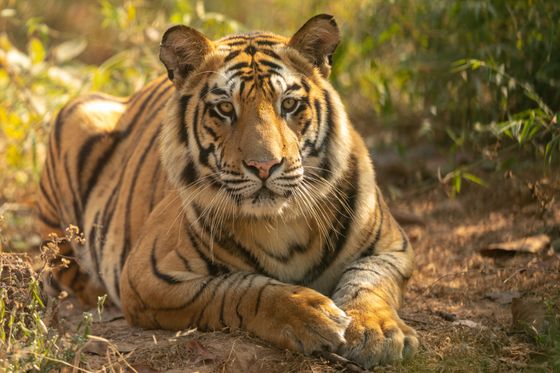
Bandhavgarh has one of the highest densities of Bengal tigers in India, set around an ancient hilltop fort in the Vindhya hills of Madhya Pradesh. Its landscape is a mix of sal forest, grassland meadows and dramatic cliffs.

Karnataka
Bandipur National Park
Bandipur National Park, in the Chamarajanagar district of Karnataka, is one of India's tiger reserves and part of the Nilgiri Biosphere Reserve. Once a hunting ground of the Mysore maharajas, its teak and rosewood forests shelter tigers, leopards, elephants, gaur and dholes, and it forms a continuous wildlife corridor with Nagarhole, Mudumalai and Wayanad.

Odisha
Bhitarkanika National Park
Bhitarkanika National Park in Odisha protects one of India's largest mangrove ecosystems, a maze of tidal creeks and forests fed by several rivers. It is famed for its huge saltwater crocodiles, along with king cobras, water monitors and vast numbers of birds; nearby Gahirmatha beach is a major nesting site for Olive Ridley sea turtles.

Jammu & Kashmir
Dachigam National Park
Dachigam National Park, in the mountains just outside Srinagar in Jammu and Kashmir, is the last stronghold of the endangered Kashmir stag, or hangul, the state animal. Rising from riverine valley to alpine meadow, it also shelters Himalayan black bears, leopards, musk deer and a wealth of Himalayan birds.

Assam
Dehing Patkai National Park
India's largest surviving stretch of lowland rainforest sits here, 231 square kilometres of dipterocarp forest across Dibrugarh and Tinsukia districts, part of a belt that runs on for more than 575 sq km and over into Arunachal Pradesh. Protection came late, a wildlife sanctuary only in 2004 and a national park in 2020, and it doubles as an elephant reserve. It was a study of the white-winged wood duck that first made the case for the place, which tells you what it is really about: go expecting birds and canopy rather than a set-piece safari.
.jpg/960px-Desert_National_Park_(50861830528).jpg)
Rajasthan
Desert National Park
Desert National Park, spread across the Thar desert near Jaisalmer and Barmer in Rajasthan, is one of India's largest protected areas and the last stronghold of the critically endangered Great Indian Bustard. Its dunes, scrub and rocky expanses shelter desert foxes, chinkara, desert cats and raptors, along with ancient fossils.

Assam
Dibru-Saikhowa National Park
Water sets the terms here. The park lies between the Brahmaputra and Lohit in the north and the Dibru in the south, at an average of 118 metres, and it holds the largest salix swamp forest in northeast India along with canebrakes and grassland. Rainfall runs from 2,300 to 3,800 mm a year, so summer is hot and thoroughly wet; winter is cool and usually dry, which is the sane time to come. Fish diversity is one of its real distinctions, not the headline most visitors want, but it tells you this is a river park more than a forest one.

Uttar Pradesh
Dudhwa National Park
Dudhwa National Park, part of the Dudhwa Tiger Reserve in the Terai grasslands of Uttar Pradesh near the Nepal border, protects one of India's finest surviving stretches of tall wet grassland and sal forest. It is a stronghold for tigers, the rare swamp deer (barasingha) and reintroduced one-horned rhinos, along with elephants and rich birdlife.
Gujarat
Gir National Park
Gir is the last refuge of the Asiatic lion, the only place on earth outside Africa where wild lions roam. This dry deciduous forest in Saurashtra also shelters leopards, antelope and over 300 bird species across its safari routes.
Himachal Pradesh
Great Himalayan National Park
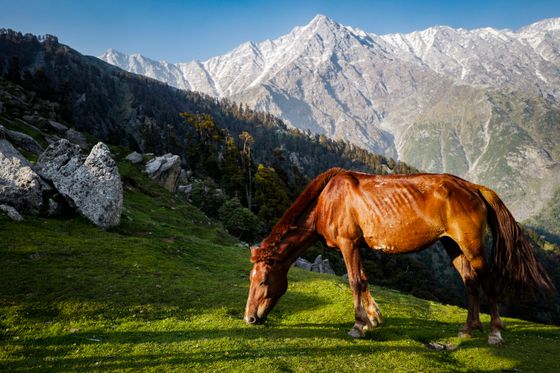
The Great Himalayan National Park was listed by UNESCO in 2014, and what makes it worth the effort is what it does not have: no road crosses it, nothing is sold inside it, and there is no signal past the boundary. Entry is on a permit, issued at Sai Ropa or Gushaini. Past the gate you walk. The standard trips run two to five days up the Tirthan, Sainj or Jiwa valleys with a local guide and a porter, and the community booking system means the money stays in the villages at the edge. Himalayan brown bear, musk deer and western tragopan all live in here and you will probably see none of them — this is dense forest, not grassland. What you get instead is four days without meeting anyone. The ecozone villages outside the boundary — Gushaini, Ropa, Shangarh — are where you sleep before and after, and each is worth a night either side. Mid-May to the end of June, and mid-September to the end of October. The higher passes hold snow outside that, and the monsoon closes the trails.
Uttarakhand
Jim Corbett National Park
Jim Corbett is India's oldest national park and the birthplace of Project Tiger, set in the Himalayan foothills along the Ramganga River. Famed for its tigers, elephants and rich birdlife across the Dhikala, Bijrani and Jhirna zones, it is one of the country's safari destinations.

Chhattisgarh
Kanger Valley National Park
Roughly 200 square kilometres of Bastar, running about 33.5 km from the Teerathgarh waterfalls in the west to the Kolab river on the Odisha boundary, and only some 6 km deep north to south. The Kanger river runs through the middle and gives the park its name. It is one of India's densest national parks, and the rock beneath it is limestone, so the underground caves are as much of the draw as the wildlife. Listen for the Bastar hill myna, the state bird. The park sits 30 km southeast of Jagdalpur, close enough to make a day of rather than an expedition.

Madhya Pradesh
Kanha National Park
Kanha is one of India's largest and most beautiful tiger reserves, a landscape of sal forests and open meadows said to have inspired Kipling's 'The Jungle Book'. It is also the last home of the rare barasingha (swamp deer).

Telangana
Kasu Brahmananda Reddy National Park
This was a prince's estate before it was a park. The palace complex went to Mukarram Jah at his coronation in 1967, and only in 1998 did the state declare its 390 acres a national park. What sits around the palace is the odd inventory of a vanished household: a peacock bungalow on a hillock, the round Gol Bungalow, stables built for elephants, horses and cattle, a motor khana that once held a fleet of vintage cars, two wells and two water tanks. It is in the middle of Jubilee Hills, which is exactly the point, a jungle inside the concrete one.

Assam
Kaziranga National Park
Kaziranga covers over 430 square kilometres of alluvial floodplain along the southern bank of the Brahmaputra in Assam. It is marsh country, thick with towering elephant grass, shallow reed swamps and stands of open sal forest. More than two-thirds of the world's surviving one-horned rhinos live here. The park is divided into four safari ranges and run under strict rules. Bagori is the popular one for early-morning elephant-back safaris, which get you close to rhinos grazing in the mist without disturbing them.

Manipur
Keibul Lamjao National Park
No other national park in the world floats. The surface here is phumdi, mats of decomposed plant material, and the forty square kilometres of it are an inseparable part of Loktak Lake rather than a park beside it. The place was set aside in 1966 as a sanctuary for the endangered Eld's deer, the state animal of Manipur, and gazetted a national park in 1977. UNESCO holds it on the tentative list as the Keibul Lamjao Conservation Area, a larger boundary taking in the Loktak buffer and Pumlen Pat. Go for the deer; the park exists because of them.

Rajasthan
Keoladeo National Park (Bharatpur)
Keoladeo National Park in Bharatpur, Rajasthan, is a UNESCO World Heritage Site and one of the world's finest bird sanctuaries. A man-made wetland created by a former ruler, it hosts hundreds of resident and migratory bird species, from painted storks and herons to wintering waterfowl, and was historically a rare wintering ground of the Siberian crane.

Sikkim
Khangchendzonga National Park
India's first mixed World Heritage site, listed in July 2016 for its nature and its culture together, which is the unusual part. The park covers 1,784 square kilometres around Kangchenjunga, the third-highest mountain on earth at 8,586 metres, and forms the core of the Khangchendzonga Biosphere Reserve. This is trekking country rather than drive-through country, so plan in days rather than an afternoon and go in with a route already settled.

Assam
Manas National Park
Manas National Park, in the Himalayan foothills of Assam on the border with Bhutan, is a UNESCO World Heritage Site, tiger reserve, elephant reserve and biosphere reserve in one. Its grasslands and forests along the Manas river shelter tigers, rhinos, wild elephants and rare species such as the pygmy hog, golden langur and Bengal florican.

Andaman & Nicobar Islands
Mount Harriet National Park
Look at the back of a twenty-rupee note: that picture was taken here. The park was set up in 1969 and covers only 4.62 sq km, wrapped around the 383-metre peak now called Mount Manipur, third-highest in the archipelago and well below Saddle Peak. Small does not mean empty. Andaman wild pigs, saltwater crocodiles, turtles and robber crabs live in it, and it is a serious butterfly spot, which is the real argument for walking slowly and looking down as often as up. The name remembers Harriet Tytler, wife of the settlement's superintendent in the 1860s.
Tamil Nadu
Mudumalai National Park
Mudumalai National Park, in the Nilgiri Hills of Tamil Nadu, is a key part of the Nilgiri Biosphere Reserve, adjoining Bandipur, Nagarhole and Wayanad. Its mix of deciduous forest, grassland and swamp supports tigers, elephants, gaur, leopards and rich birdlife, and it lies on the scenic route between Ooty and Mysuru.

Karnataka
Nagarhole National Park
Nagarhole National Park (Rajiv Gandhi National Park), in Karnataka's Kodagu and Mysuru districts, is a lush tiger reserve within the Nilgiri Biosphere. Its rivers, teak forests and the Kabini backwaters support tigers, leopards, elephants and dholes, and the Kabini zone is famous among wildlife photographers for rare sightings of the black panther.

Arunachal Pradesh
Namdapha National Park
Namdapha National Park, in the Changlang district of eastern Arunachal Pradesh, is one of India's largest and most biodiverse protected areas. Ranging from tropical forest to snow-capped peaks, it is the only park in India believed to host four big cats - tiger, leopard, clouded leopard and snow leopard - along with the rare red panda and hoolock gibbon.

Assam
Nameri National Park
Nameri National Park, in the Sonitpur district of Assam at the foothills of Arunachal Pradesh, is a birdwatcher's paradise along the Jia Bhoroli river. Famed for the rare white-winged wood duck, it also shelters elephants, tigers, leopards and clouded leopards, and has gentle rafting down the Jia Bhoroli through forest.

Uttarakhand
Nanda Devi National Park
Nanda Devi National Park, in the Chamoli district of Uttarakhand, surrounds Nanda Devi, India's second-highest peak, in a high-Himalayan glacial basin. A UNESCO World Heritage Site, it shelters snow leopards, Himalayan musk deer, bharal (blue sheep) and Himalayan tahr amid dramatic peaks, glaciers and alpine meadows.
_on_the_Prowl_in_the_Narara_Marine_National_Park.jpg/960px-The_Western_Reef_Heron_(dark_morphed)_on_the_Prowl_in_the_Narara_Marine_National_Park.jpg)
Gujarat
Narara Marine National Park Beach
A unique coastal area where low tide allows visitors to walk shallow waters and observe living corals, sea anemones, and crabs up close.

Uttarakhand
Rajaji National Park
Rajaji National Park, spread across the Shivalik foothills of Uttarakhand near Haridwar, Rishikesh and Dehradun, is a tiger reserve best known for its large population of Asian elephants. The Ganga flows along its edge, and its sal forests and grasslands shelter elephants, tigers, leopards, deer and over three hundred bird species.
Rajasthan
Ranthambore National Park
Ranthambore is one of the largest and best-known wildlife sanctuaries in northern India, with a thriving population of the endangered Royal Bengal tiger. It lies in Sawai Madhopur district, where the ancient Vindhya and Aravalli ranges meet, and the ground is a mix of rugged rocky cliffs, dry deciduous forest and lakes linked one to the next. The 10th-century Ranthambore Fort stands inside the forest, and it is what makes the park look like nowhere else. Tigers here hunt in broad daylight, across the old stone ruins, the palace pavilions and the lake edges. The park is run under strict environmental rules and divided into ten safari zones, which keeps the vehicles spread out and the pressure off the ecological core.

Maharashtra
Sanjay Gandhi National Park
Sanjay Gandhi National Park, in the northern suburbs of Mumbai, is a rare protected forest within a megacity and one of the world's most-visited national parks. Its forests are famous for a resident leopard population living alongside the city, and the park also holds the ancient Kanheri Caves, lakes, a toy train and popular nature trails.
.jpg/960px-A_scene_from_Siroy_National_Park%2C_Manipur_(1).jpg)
Manipur
Shirui National Park
One flower carries this park. The Shirui lily grows naturally on these slopes, and it is what most people make the journey up to Ukhrul for. The walk to Shirui Kashong Peak, at 2,835 metres, gives you the view and the birds together: Blyth's tragopan and Mrs Hume's bar-backed pheasant both live on the hilltop, and a number of rivers start from it. Tiger and leopard are on the list for the park, established in 1982, but treat that as a matter of record rather than something you will see.

Kerala
Silent Valley National Park
Silent Valley National Park, in the Nilgiri Hills of Kerala's Palakkad district, protects one of India's last undisturbed tracts of tropical evergreen rainforest. Part of the Nilgiri Biosphere, it is known for its endemic lion-tailed macaque, rich birdlife and river ecosystem, and is famous as the focus of a landmark environmental movement that saved it from a dam.

Odisha
Simlipal National Park
Simlipal National Park, in the Mayurbhanj district of Odisha, is a tiger reserve and biosphere reserve set among rolling sal forests, plateaus and waterfalls. It is one of the few places associated with rare melanistic (black) tigers, and also shelters elephants, leopards and gaur, along with the Barehipani and Joranda waterfalls.
West Bengal
Sundarbans National Park
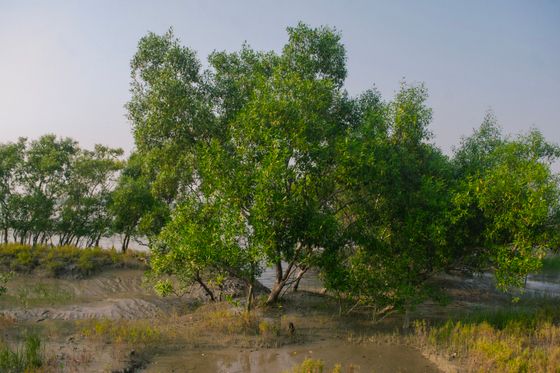
The Sundarbans National Park is the largest continuous mangrove forest on earth — a vast estuarine delta in West Bengal formed where the Ganges and Brahmaputra meet, cut into a maze of tidal mudflats, narrow river channels and dense island swamps. It holds the world's only population of tigers adapted to living in a mangrove habitat. There is no safari on land here; it is all done from the water, on licensed multi-deck passenger boats that work along the thick roots of the Sundari trees. The core reserve also holds saltwater crocodiles, water monitors and river dolphins.
Uttarakhand
Valley of Flowers National Park
A UNESCO World Heritage Site in the high Himalayas famed for its vast meadows of endemic alpine flowers blooming in monsoon. The Valley of Flowers National Park is an Indian national park located in North Chamoli, deep within the West Himalaya region. It is known for its alpine meadows carpeted with hundreds of species of colourful wild orchids, poppies, and primulas.

Sasan Gir (Talala)
Gir National Park Safari
The regulated core of the forest, covered on guided jeep routes: Asiatic lions, leopards, sambar and spotted deer.


