

Daulatabad Fort
heritage site · Maharashtra
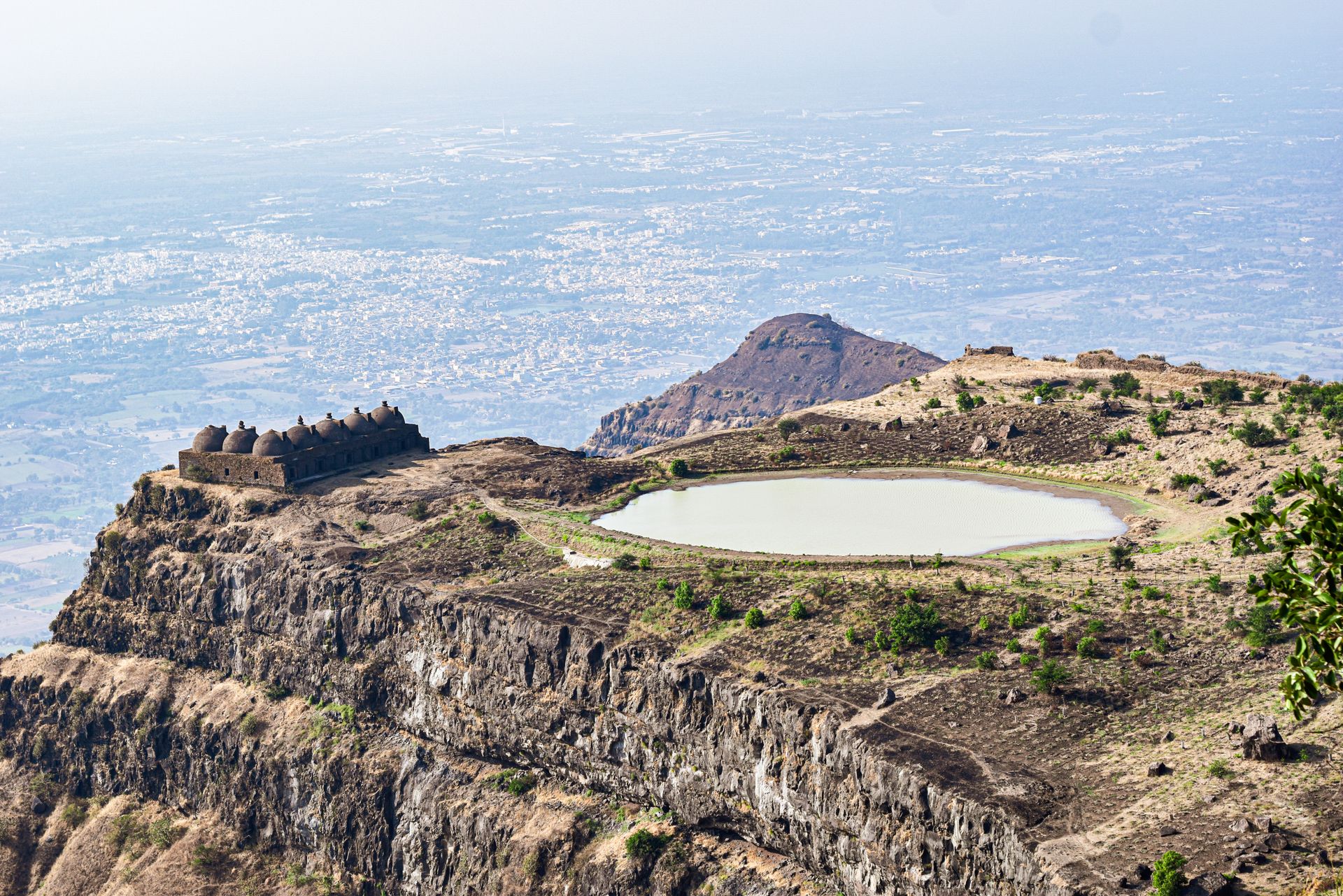
Daulatabad Fort (historically Devagiri) stands atop a steep 200-metre conical hill roughly 15-16 km northwest of Chhatrapati Sambhajinagar (Aurangabad), Maharashtra.

.jpg/960px-Daulatabad_Fort_vrvbajel0924_(398).jpg)
.jpg/960px-Daulatabad_Fort_vrvbajel0924_(408).jpg)
.jpg/960px-Daulatabad_Fort_vrvbajel0924_(388).jpg)
.jpg/960px-Daulatabad_Fort_vrvbajel0924_(282).jpg)
- State
- Maharashtra
- Type
- Heritage Site
Daulatabad Fort (historically Devagiri) stands atop a steep 200-metre conical hill roughly 15-16 km northwest of Chhatrapati Sambhajinagar (Aurangabad), Maharashtra. It is a massive fortified hill-city built up over about 1,000 years, enclosed by three concentric fortification walls and two moats, best known for Sultan Muhammad bin Tughluq's failed 14th-century attempt to shift the Delhi Sultanate's capital here.
Daulatabad Fort is known for
A short history
The city was founded around 1187 as Devagiri by the Yadava king Bhillama V. The Yadavas began the hill's unique fortification by scarping its slopes into a smooth vertical rock face about 50 m high. Alauddin Khalji annexed the city in 1296-1308. In 1327-1328, Sultan Muhammad bin Tughluq renamed the city Daulatabad ("abode of wealth") and ordered the imperial capital moved here, along with a mass migration of Delhi's population. The arid conditions and logistical strain caused the plan to fail, and the capital reverted to Delhi by 1334. The fort passed to the Bahmani Sultanate from 1347, whose ruler built the 30-metre Chand Minar tower. Control passed to the Nizam Shahis of Ahmadnagar in 1499, who made it their capital from 1607. The Mughals under Aurangzeb captured the fort after a four-month siege in 1632-1633. It later came under Maratha control in 1760, and the Nizams of Hyderabad held it from 1724 until Indian independence. [Source: en.wikipedia.org/wiki/Daulatabad_Fort; Source: asi.nic.in/daulatabad-fort/]
Why Daulatabad Fort matters
Daulatabad is regarded as one of India's most impregnable and ingeniously engineered hill forts, and its role as Muhammad bin Tughluq's short-lived capital makes it a landmark case study in medieval Indian history, protected as an ASI monument of national importance.
When to go
October to March
Why visit
Muhammad bin Tughlaq marched Delhi's whole population here in 1327 and marched them back a few years later. The thing to see is the pitch-dark spiral tunnel near the top, built as a killing corridor — a guide with a torch is worth the money.
Cultural notes
The complex includes the Chand Minar tower and Chini Mahal; its layers reflect Yadava, Delhi Sultanate, Bahmani and Mughal rule.
How to reach
The fort lies about 15-16 km from Chhatrapati Sambhajinagar (Aurangabad) city on the Aurangabad-Ellora road; Daulatabad railway station on the Manmad-Purna line sits nearby, and Chhatrapati Sambhajinagar Airport is the nearest airport.
Daulatabad Fort guide & itineraries
Shopping
Small stalls near the base sell water, snacks and souvenirs; Aurangabad city is the place for Paithani textiles and Bidriware.
Frequently asked questions
Why was Daulatabad Fort considered impregnable?
It combines a steep conical hill, concentric walls, a moat and a single dark, winding tunnel that could be easily defended, making direct assault very difficult.
Is the climb difficult?
Yes, it is a long, steep climb of a few hours including many steps and a dark passage, so good shoes, water and an early start are recommended.
More to explore in Maharashtra
Other places worth pairing with this visit — tap a mood to reshape the list.


Travellers exploring here also loved


.jpg/1920px-Shaniwar_wada_(pune).jpg)
People also explored
Travellers viewing Daulatabad Fort also loved these

.jpg/1920px-Ratnagiri%2C_Velneshwar_-_panoramio_(100).jpg)


More heritage & forts
More places you'll love


.jpg/1920px-India_Gate_(All_India_War_Memorial).jpg)


Trending in Maharashtra


Where next?
More like Daulatabad Fort
Or a different kind of trip