Celebrate India
India's calendar bursts with religious, regional, musical, cultural and culinary celebrations. Filter by month, type or state to plan around the right moment.
Happening soon
Indian festivals mostly follow lunar calendars, so the exact days shift each year. We name the month they fall in and leave the day to the panchang closer to the time.
Festival calendarFestival directory
Use the calendar when timing is the main decision, or browse the directory for context, location and meaning.

Tendong Hill above Damthang, near Namchi in South Sikkim, is the sacred centre.
One of the oldest festivals in Sikkim and the most important in the Lepcha calendar — the Lepchas are the state's indigenous people, and this is their own thanksgiving.
The tourist resort at Reiek village, 29 km from Aizawl, Mizoram, on the slope of Reiek Tlang.
A modern government event rather than a traditional festival — launched by the Tourism Department with the Horticulture Department to build a market for a cash crop.
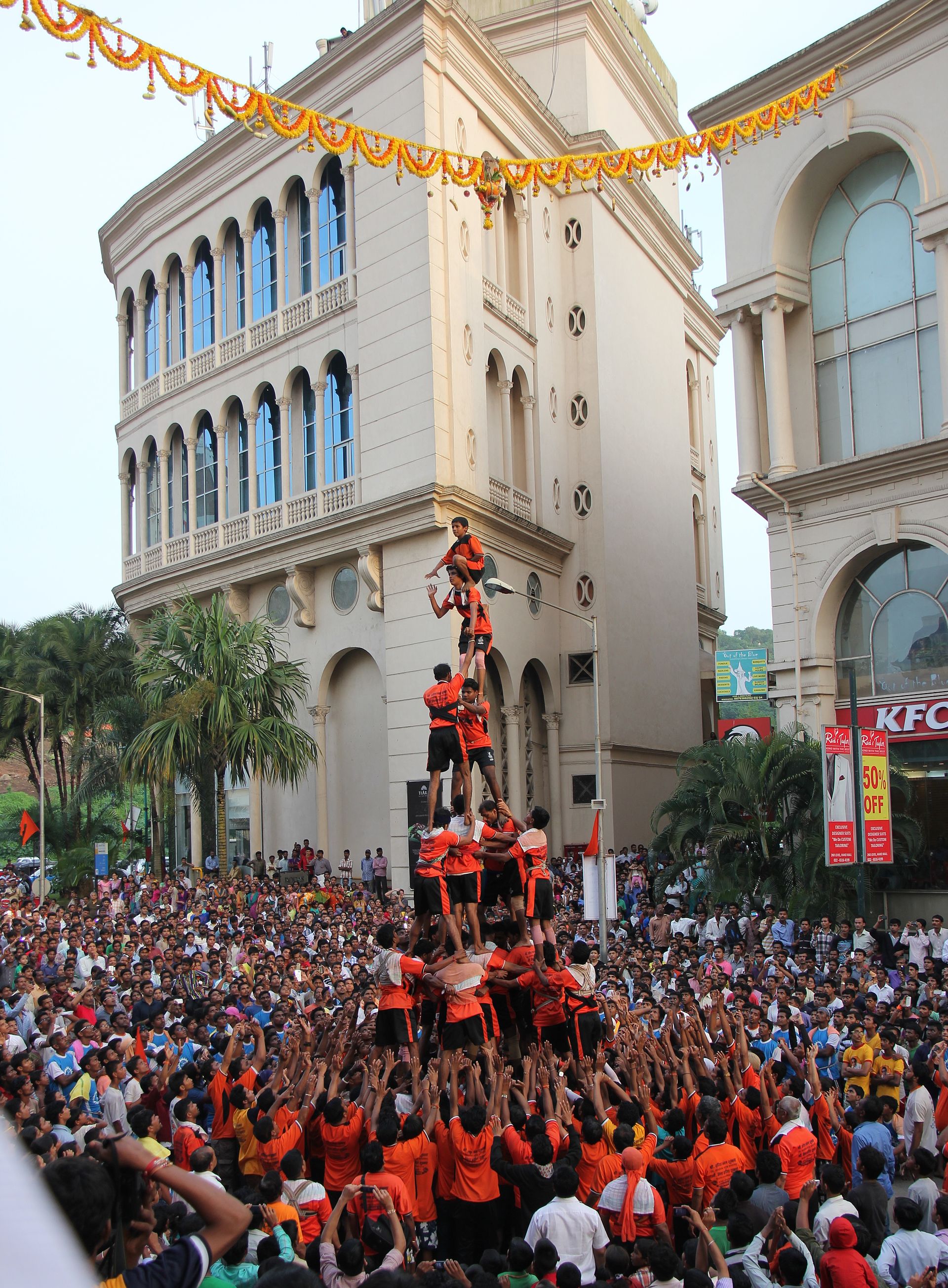
Mumbai, Thane, Pune, and towns across Maharashtra
Athletic troupes called Govindas build multi-tiered human pyramids to break clay curd pots suspended high in the air.

Celebrated with unparalleled grandeur in Maharashtra (especially Mumbai and Pune), Goa, Karnataka, Andhra Pradesh, Telangana, and Tamil Nadu.
The birthday of Lord Ganesha, the remover of obstacles. Marked by grand clay idols, public pandals and immersion processions, especially in Maharashtra.
The moat at Sagolband Bijoy Govinda Leikai, Imphal West district.
A royal-era socio-religious rite counted continuously for well over two centuries — 2025 was the 247th edition.

Jharkhand, Odisha, West Bengal, and Chhattisgarh, heavily observed by the Munda, Oraon, Santhal, and Ho tribes.
An indigenous nature festival in which tribal youth plant and worship a branch of the Karam tree to protect the family.

Celebrated throughout India, with its most vibrant spiritual centers in Mathura and Vrindavan (Uttar Pradesh), and energetic public displays (Dahi Handi) in Mumbai and across Maharashtra.
Celebrates the birth of Lord Krishna. Marked by midnight prayers, fasting, devotional singing, and the Dahi Handi human-pyramid tradition.

Western Odisha districts, primarily Sambalpur, Balangir, Bargarh, and Kalahandi.
A community harvest festival for eating the season's first freshly harvested rice.

Across Sikkim, with the absolute cultural and ritual centerpiece performed at the Tsuklakhang Royal Palace Monastery courtyard in Gangtok.
A grand historical festival honouring Mount Khangchendzonga as the active warrior guardian deity of Sikkim.

Kinnaur district, Himachal Pradesh, prominent across valleys like Sangla and Kalpa.
The festival of flowers, when tribal youth trek to the high ridges to gather wild blossoms in honour of the village spirits.

Throughout Maharashtra, particularly prominent in the Vidarbha region, as well as rural pockets of Madhya Pradesh and Chhattisgarh.
An agrarian festival given over entirely to decorating, feeding, and worshipping the working farm bulls.

Across the Siang, East Siang, Upper Siang, and Lower Siang districts of Arunachal Pradesh, with major public events in Pasighat.
The principal harvest festival of the Adi tribe, celebrated with cattle sacrifices and rounds of the Ponung folk dance.

Tarnetar village, near Thangadh, Surendranagar district, Gujarat.
A legendary matchmaking and folk dance fair centred around the Trinetreshwar Mahadev Temple, famous for embroidered umbrellas.

Hosted in the breathtaking Ziro Valley of Arunachal Pradesh, the ancestral home of the indigenous Apatani tribe.
India's leading outdoor independent music festival, held in a Himalayan valley among Apatani tribal lands, where indie music meets eco-tourism.

Across Andhra Pradesh, especially the coastal districts.
A traditional festival where married women fast for their husbands' health, enjoying small rice crepes and evening swings.

Telangana and parts of Andhra Pradesh
A grand floral festival celebrated by women who arrange seasonal wildflowers into concentric pyramids to honour Goddess Gauri.

Preeminent in West Bengal, Odisha, Assam, and among the Bengali diaspora.
The grand worship of Goddess Durga's victory over the demon Mahishasura. Famous for elaborate themed pandals, artistic idols, and immersion processions, especially in Kolkata.

Celebrated pan-India; most famous in Mysore (Karnataka), Kullu Valley (Himachal Pradesh), Bastar (Chhattisgarh), West Bengal (as Durga Puja's end), and northern Ramlila venues.
Celebrates Lord Rama's victory over the demon king Ravana and Goddess Durga's slaying of Mahishasura. Marked by burning towering effigies of Ravana.

Jhiri village, about 14 km from Jammu city.
One of the largest rural fairs in the Jammu region, and unusual in that its object of devotion is a cultivator who died over a question of agricultural justice rather than a deity or a king.

Bihar, Jharkhand and the Purvanchal region of Uttar Pradesh.
An exceptionally strict 36-hour waterless fast observed by mothers to pray for the survival and success of their children.

Predominantly celebrated across Northern and Western India, including Punjab, Haryana, Rajasthan, Himachal Pradesh, and Uttar Pradesh.
A day when married women observe a dawn-to-moonrise fast for the wellbeing and longevity of their husbands, ending after sighting the moon.

Centering entirely at the Dhalpur Maidan in the Kullu Valley of Himachal Pradesh.
A unique week-long festival where over 200 village deities are carried in palanquins to honour Lord Raghunath — a grand convergence of Himachali hill culture.

Jodhpur, Mandore vistar, Rajasthan.
Brings the classical folk music, heroic desert poetry, and traditional dances of the Marwar rulers to Mehrangarh Fort.

Centered in the historic royal city of Mysuru (Mysore) in the state of Karnataka.
Karnataka's 400-year-old royal state festival, famous for the illuminated Mysore Palace and the grand Jamboo Savari elephant procession on Vijayadashami.

Celebrated nationwide across India, with iconic Garba and Dandiya dances in Gujarat, and massive public celebrations across Mumbai and Delhi.
Nine nights of devotion, fasting and dance celebrating the divine feminine. Marked by Garba and Dandiya-Raas folk dances, especially in Gujarat.

Smit village, Khasi Hills district, Meghalaya.
An elegant harvest thanksgiving dance of the indigenous Khasi tribe performed by the royal family in heavy gold attire.

North Malabar region (Kannur, Kasaragod districts) of Kerala
An ancient ritual dance-theatre where artists undergo divine transformation, becoming living gods to grant village blessings.

Tirumala Venkateswara Temple, Tirupati, Andhra Pradesh
A grand cleansing festival initiated by Lord Brahma. Features daily morning and evening vehicle (vahanam) processions of Lord Venkateswara.
The Saraswati Tirtha ghats at Pehowa town, Kurukshetra district, Haryana.
One of very few tirthas in India where shradh and tarpan are performed specifically for those who died by accident or before their time.

The Hazratbal shrine on the western shore of Dal Lake, Srinagar, Jammu & Kashmir.
The most venerated Muslim shrine in Kashmir, and the display is the occasion on which the relic that gives it that standing is actually visible.
All ten inhabited islands, but observed under two names: Bakrid on the nine northern islands, Bodu Eid on Minicoy.
The second of the two canonical Eids, and in Lakshadweep the point at which Minicoy's Maldivian cultural inheritance becomes plainly visible.
All ten inhabited islands — Kavaratti, Agatti, Amini, Andrott, Kadmat, Kalpeni, Kiltan, Chetlat, Bitra and Minicoy.
The defining civic and religious occasion of the union territory, and the day the whole archipelago keeps at once.

Rotates between Prayagraj, Haridwar, Nashik, and Ujjain.
A mass Hindu pilgrimage of faith where devotees gather to bathe at sacred river confluences, believed to cleanse sins and grant liberation (moksha). Recognised by UNESCO as Intangible Cultural Heritage.

The sacred Mahamaham Tank in Kumbakonam, Thanjavur district, Tamil Nadu.
A vast bathing pilgrimage at the holy tank, whose water is believed to gather the currents of nine sacred rivers and wash away sins.
Across all ten inhabited islands, centred on the island mosques. Kavaratti's Jamath, Mohidden and Ujra mosques are the principal ones.
By local reckoning the territory's flagship religious festival rather than one entry among many — the administration's own culture page ranks it that way.
The Nicobar group only — Car Nicobar, Chowra, Teressa, Nancowry and Kamorta. Chowra's version is the best documented.
Genuinely indigenous and pre-colonial, and the largest ceremonial event in Nicobarese life. It is not a tourist occasion and cannot be treated as one.